As often happens with my style of inquiry, there was a painful day in the weeds, trying to find a question and a way to make progress. Today was sunshine and insights. We connected the binomial theorem, geometry, derivatives of polynomials, Stokes' theorem (though not in so many words). We could link graphs to tables to geometries. Fantastic questions came up - like, REAL questions about the foundations of calculus (why can you say (dx)^2 is zero, but not dx? - how can you build up a volume from infinitely thin sheets?).
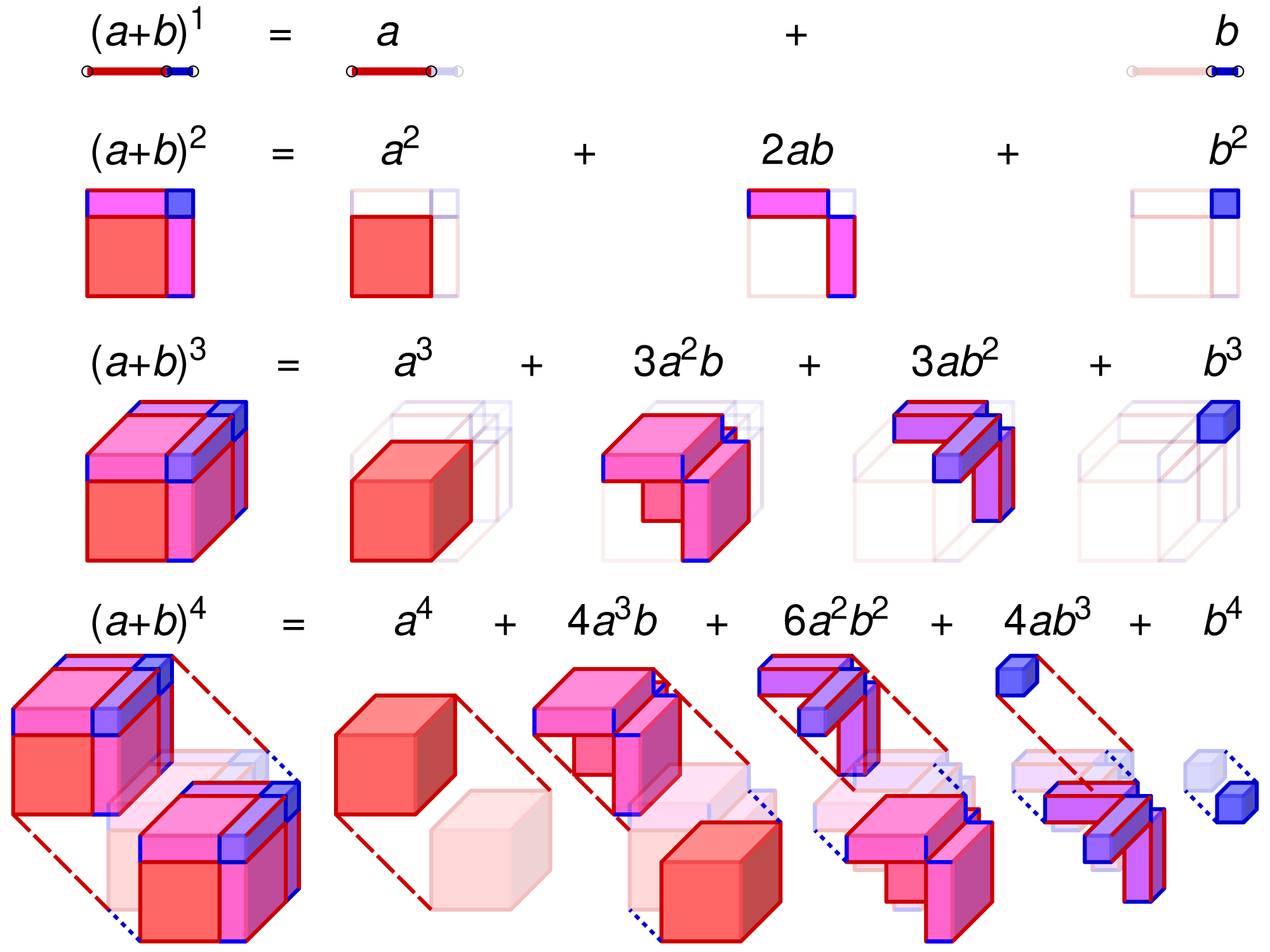
My most proud instructional moment was when I asked a question - essentially getting at the purposefully ill-defined question of WHY the derivative of x^2 (a square's area) is 2x (two sides of that square), and we were at a point where I thought someone would draw what you see in the second line below (we'd also thought about cubes and other things, and had sentences on the board stating their answers but no representations). So I asked for a representation - hoping for squares. But instead, a student carefully (OH SO CAREFULLY) drew two graphs on the board: x^2 and 2x and said how one was rising faster and faster, but not the other.
She had drawn precise points on her graph to represent (1,1) (2,4) (3,9)... on graph 1, and (1,2) (2,4) (3,6)... on graph 2. And when she said how quickly one was growing, I said "say more about that?" and I wrote out that pattern she describes -- the gaps were 1, 3, 5, 7, 9. "So this is what you mean by one grows faster and faster." I pointed this out and said "what this means, I think, is that 92^2 - 91^2 = 183!" And one student "got it" right away "You just add 91 and 92" and another student was able to say this: If you have this square (below) that is 92 x 92, and the gray one (91 x 91) the difference is the white squares on that edge: 91 + 92:

(That's actually a 92 x 92 square. Not the best use of my time.)
And another student explained it by saying that:
a^2 - b^2 = (a+b)(a-b). And since, in this case, a-b = 1, then a^2 - b^2 = a+b.
WHAT?! YAY! I wasn't anticipating that answer until I visited her group, and I loved it. So now we have these two representations on the board (I held off on her explanation until we had the physical/geometry explanation because I didn't want too much emphasis on crunching math to start our discussion).
And this left us with the question of why (a+b) and not (2a) (the derivative is 2x, not (x + x + dx)); I had them take it to 3d (half the class) and the other half work on the question of what would happen if we weren't looking at 91 --> 92 (or a + a + 1), but, instead, a dx, or maybe 91 --> 91.001.
The broader question behind this was: it is SO WEIRD to me that the derivative of x^n is n x^(n-1). That's just too cute to be coincidence. There has to be something going on here. And by the end we were tying it back to the binomial theorem.
In this, the moment of instructional fear happened as Lauren was taking 5 minutes to carefully draw the graphs of x^2 and 2x. And it is only because of my depth of content knowledge that I found this way forward - by attending to the gaps in her x^3 graph; of knowing that, with the diagrams on the board, someone will be able to connect those gaps to growing squares, and that - if the square/linear relationship is not "too cute to be coincidence" then surely being able to tell everyone what 92^2 - 91^2 is is too cute. (There are few calculus ideas that I know and love as much as this one - and it goes back to making stop-motion videos of things falling to think about what constant acceleration means.)
