The final perspective that I will address in this review argues for a view of subject- matter instruction in which access to ways of producing knowledge is at the heart of social justice. The focus on ways of producing knowledge is distinct from ways of knowing, in that ways of producing knowledge evokes the need for a tool of some type, namely, the tool of language. Both oral and written language are the focus of this perspective, with a particular emphasis on how young people might be apprenticed into the nuanced differences in producing knowledge via written language across multiple disciplines. To be sure, this perspective recognizes the importance of understanding the accumulated knowledge of each discipline but also argues that knowing how to produce knowledge—and thereby how to critique its production— is where power in the disciplines lies, in part because it provides access to content knowledge and in part because it provides access to the discourse communities of the disciplines who produce that knowledge. In other words, some of the power of knowledge comes from being an active part of its production rather than from merely possessing it. Some theorists and researchers would even argue that a student of discipline does not really know the discipline unless she or he knows how to produce knowledge—with some facility—in it. Of the study of history, for example, Leinhardt (1994) argued, "History is layered, and the teaching of it, like other subjects, involves not only a process of acquiring the stuff of the discipline but acquiring a particular rhetorical stance toward it. The artifacts of any given course (multiple texts, documents, discussions, and required essays) and the roles of the teachers and students are unique." (p. 218).... she goes on, but I've been thinking about ways to connect the work in Inquiry with the work on social justice pedagogy and this connection seems clear.
Wednesday, November 30, 2016
Moje
What is meant by "socially just" subject matter instruction:

Friday, November 11, 2016
Split tasks
This is starting to get at the "tribe"/"my people"/"teaching about belief" strand. It's half baked, and mostly just a set of things I did in class as a (meta)response to the election.
Yesterday I began class with a question from the FCI, and planned to first ask "what's the right answer" and then as "what answer makes the most sense?" (a mis-statement of the Elby/McCaskey task) By the time I checked in on the first task (do we agree on the right answer?), students were already saying "so the right answer is D, but it's hard to believe it's not A..." - which segued nicely.
The next question I asked:
Is this a problem? Is your job as a teacher to get your students to understand what scientists say, or to agree with what scientists say?
And, more specifically, as I went to tables:
Let's say you gave the FCI and your students do the best anyone has ever done. Every student circles the correct answer for every problem. But they "square" other answers. Is this a problem? Have you done your job? is your job to teach them what scientists believe, or to make sure they agree with it?
The conversation was pretty intriguing and mostly were arguments about how really understanding something might entail it 'making sense' and that might then entail 'belief' (one student brought up the term 'belief' which was great). If students don't agree, they probably don't understand. The more fundamental goal is the second goal - agreement. We discussed the problem of tests in getting at these ideas and in measuring what teachers do. It was a good discussion. I pushed them to consider how this is problematic not only for really understanding the concepts, but for really understanding what science is all about. I asked the David Hammer question - "if I throw two balls: one out and one down, which hits first?" - and mentioned how the obviously right answer is something that people say before a physics class but not after a physics class. Education *does* this to us - and another student pipes up to say "I thought they would hit at the same time -- I see what you mean."
And then - where I wanted to lead this - was the question of evolution. Believing Newton's Laws is not positioned by our culture as very problematic. But is it your job (as a biology teacher) that students leave your room understanding evolution or believing evolution? (Because that distinction was deeply problematic for me when I taught evolution. One side of me wants to say that I need them only to understand the scientific ideas and arguments; but the other side of me honestly hopes they agree with that.) We worked through some evolution curriculum I wrote for LSET and discussed "intellectual empathy" for students' beliefs. And I shared how when I taught this - even as I tried to be empathetic and anticipate their responses - I failed. Students were upset. But I had a classroom culture where the students who did not believe in evolution could voice that and we could still all love each other. I think, all in all, it was a successful unit and an incredible class.
In class this discussion went great - next time I'd have more carefully planned 'products' from our discussions, but this question really did intrigue us and they wrestled with them earnestly. There was discussion about how science moves forward by those moments when your squares and circles don't overlap - that pedagogically it's actually a productive place to be. I loved this (we have one student who is really great at pushing those ideas - he's awesome; you guys, these students are alright - our future is in good hands).
There's a lot more to say about this... I do teach with a hope of addressing belief and tribe. I didn't say as much to my students.
Yesterday I began class with a question from the FCI, and planned to first ask "what's the right answer" and then as "what answer makes the most sense?" (a mis-statement of the Elby/McCaskey task) By the time I checked in on the first task (do we agree on the right answer?), students were already saying "so the right answer is D, but it's hard to believe it's not A..." - which segued nicely.
The next question I asked:
Is this a problem? Is your job as a teacher to get your students to understand what scientists say, or to agree with what scientists say?
And, more specifically, as I went to tables:
Let's say you gave the FCI and your students do the best anyone has ever done. Every student circles the correct answer for every problem. But they "square" other answers. Is this a problem? Have you done your job? is your job to teach them what scientists believe, or to make sure they agree with it?
The conversation was pretty intriguing and mostly were arguments about how really understanding something might entail it 'making sense' and that might then entail 'belief' (one student brought up the term 'belief' which was great). If students don't agree, they probably don't understand. The more fundamental goal is the second goal - agreement. We discussed the problem of tests in getting at these ideas and in measuring what teachers do. It was a good discussion. I pushed them to consider how this is problematic not only for really understanding the concepts, but for really understanding what science is all about. I asked the David Hammer question - "if I throw two balls: one out and one down, which hits first?" - and mentioned how the obviously right answer is something that people say before a physics class but not after a physics class. Education *does* this to us - and another student pipes up to say "I thought they would hit at the same time -- I see what you mean."
And then - where I wanted to lead this - was the question of evolution. Believing Newton's Laws is not positioned by our culture as very problematic. But is it your job (as a biology teacher) that students leave your room understanding evolution or believing evolution? (Because that distinction was deeply problematic for me when I taught evolution. One side of me wants to say that I need them only to understand the scientific ideas and arguments; but the other side of me honestly hopes they agree with that.) We worked through some evolution curriculum I wrote for LSET and discussed "intellectual empathy" for students' beliefs. And I shared how when I taught this - even as I tried to be empathetic and anticipate their responses - I failed. Students were upset. But I had a classroom culture where the students who did not believe in evolution could voice that and we could still all love each other. I think, all in all, it was a successful unit and an incredible class.
In class this discussion went great - next time I'd have more carefully planned 'products' from our discussions, but this question really did intrigue us and they wrestled with them earnestly. There was discussion about how science moves forward by those moments when your squares and circles don't overlap - that pedagogically it's actually a productive place to be. I loved this (we have one student who is really great at pushing those ideas - he's awesome; you guys, these students are alright - our future is in good hands).
There's a lot more to say about this... I do teach with a hope of addressing belief and tribe. I didn't say as much to my students.
Thursday, November 10, 2016
Global warming
Ian asked on facebook "does anyone else feel like most of the things we spend our daily time and energy on are rearranging the deck chairs on the Titanic?"
I actually have opinions on this, and I want it to become more than opinions - a possible research direction, or something? -
So here's my take:
I think I could do a better job than most people at describing a mechanism by which global warming occurs - how one kind of clear gas makes the world heat up, and why it is that burning things creates more of that gas, and so on. But I certainly wouldn't come close to a real, complete explanation and I really really don't understand it. But I vote and act (errr... or at least feel guilty) as if this is a reality. So I don't understand global warming, I believe in global warming. And the reason I do is because I believe scientists. They're my people. I know the game they play and how papers get published and how they are trained. And even though I have my (sincere) criticisms of the scientific community, I both understand this process and- even more significantly - I see myself as the kind of person who agrees with scientists. (I also see myself as the kind of person who agrees with environmentalists, and these overlapping spheres reinforce my convictions when it comes to global warming, but I don't see myself being in a strong position for cultivating "kinds of people who agree with environmentalists.")
If I want my students to believe in global warming, it is not critical (I think) that they understand global warming -- it is more important that they feel like "I'm the kind of person who agrees with scientists."
And how do I cultivate that in students? By engaging them in doing science...
(1) I think that an open-inquiry investigation into the phases of the moon has been one of the more powerful things I've seen to get at this.
(2) I think my inquiry class does this well. (For the same reasons the moon does this well.)
... why do I think that helps?
(3) I think David Hammer's work on epistemology is right where this question lives.
(4) And the work on identity is pretty closely related.
(5) pretty much all the recent research about anti-vaxxers seems to suggest as much.
But does this really hold up? On what kind of time scale? (like, would ideas shift by the end of the semester or would it take longer?) How does this connect with activism? (does it? could it?) ("Im the kind of person who...")
I actually have opinions on this, and I want it to become more than opinions - a possible research direction, or something? -
So here's my take:
I think I could do a better job than most people at describing a mechanism by which global warming occurs - how one kind of clear gas makes the world heat up, and why it is that burning things creates more of that gas, and so on. But I certainly wouldn't come close to a real, complete explanation and I really really don't understand it. But I vote and act (errr... or at least feel guilty) as if this is a reality. So I don't understand global warming, I believe in global warming. And the reason I do is because I believe scientists. They're my people. I know the game they play and how papers get published and how they are trained. And even though I have my (sincere) criticisms of the scientific community, I both understand this process and- even more significantly - I see myself as the kind of person who agrees with scientists. (I also see myself as the kind of person who agrees with environmentalists, and these overlapping spheres reinforce my convictions when it comes to global warming, but I don't see myself being in a strong position for cultivating "kinds of people who agree with environmentalists.")
If I want my students to believe in global warming, it is not critical (I think) that they understand global warming -- it is more important that they feel like "I'm the kind of person who agrees with scientists."
And how do I cultivate that in students? By engaging them in doing science...
(1) I think that an open-inquiry investigation into the phases of the moon has been one of the more powerful things I've seen to get at this.
(2) I think my inquiry class does this well. (For the same reasons the moon does this well.)
... why do I think that helps?
(3) I think David Hammer's work on epistemology is right where this question lives.
(4) And the work on identity is pretty closely related.
(5) pretty much all the recent research about anti-vaxxers seems to suggest as much.
But does this really hold up? On what kind of time scale? (like, would ideas shift by the end of the semester or would it take longer?) How does this connect with activism? (does it? could it?) ("Im the kind of person who...")
Friday, October 21, 2016
I've been teaching calculus
I've had a few days in a calculus class to think about open ended questions. I want, more broadly, to start thinking about ill-defined problems and creating "makerspace" cultures / design-thinking across the curriculum. (That is, English doesn't "own" writing, and attending to writing in our classes improves them; similarly, Engineering doesn't "own" design - working in ill-defined spaces, refining questions, justifying solutions - and I want to think about how we can incorporate those ideas in various classes... and part of the joy of being in Education and not Physics is that it's totally reasonable to play in other disciplines!)
As often happens with my style of inquiry, there was a painful day in the weeds, trying to find a question and a way to make progress. Today was sunshine and insights. We connected the binomial theorem, geometry, derivatives of polynomials, Stokes' theorem (though not in so many words). We could link graphs to tables to geometries. Fantastic questions came up - like, REAL questions about the foundations of calculus (why can you say (dx)^2 is zero, but not dx? - how can you build up a volume from infinitely thin sheets?).
My most proud instructional moment was when I asked a question - essentially getting at the purposefully ill-defined question of WHY the derivative of x^2 (a square's area) is 2x (two sides of that square), and we were at a point where I thought someone would draw what you see in the second line below (we'd also thought about cubes and other things, and had sentences on the board stating their answers but no representations). So I asked for a representation - hoping for squares. But instead, a student carefully (OH SO CAREFULLY) drew two graphs on the board: x^2 and 2x and said how one was rising faster and faster, but not the other.
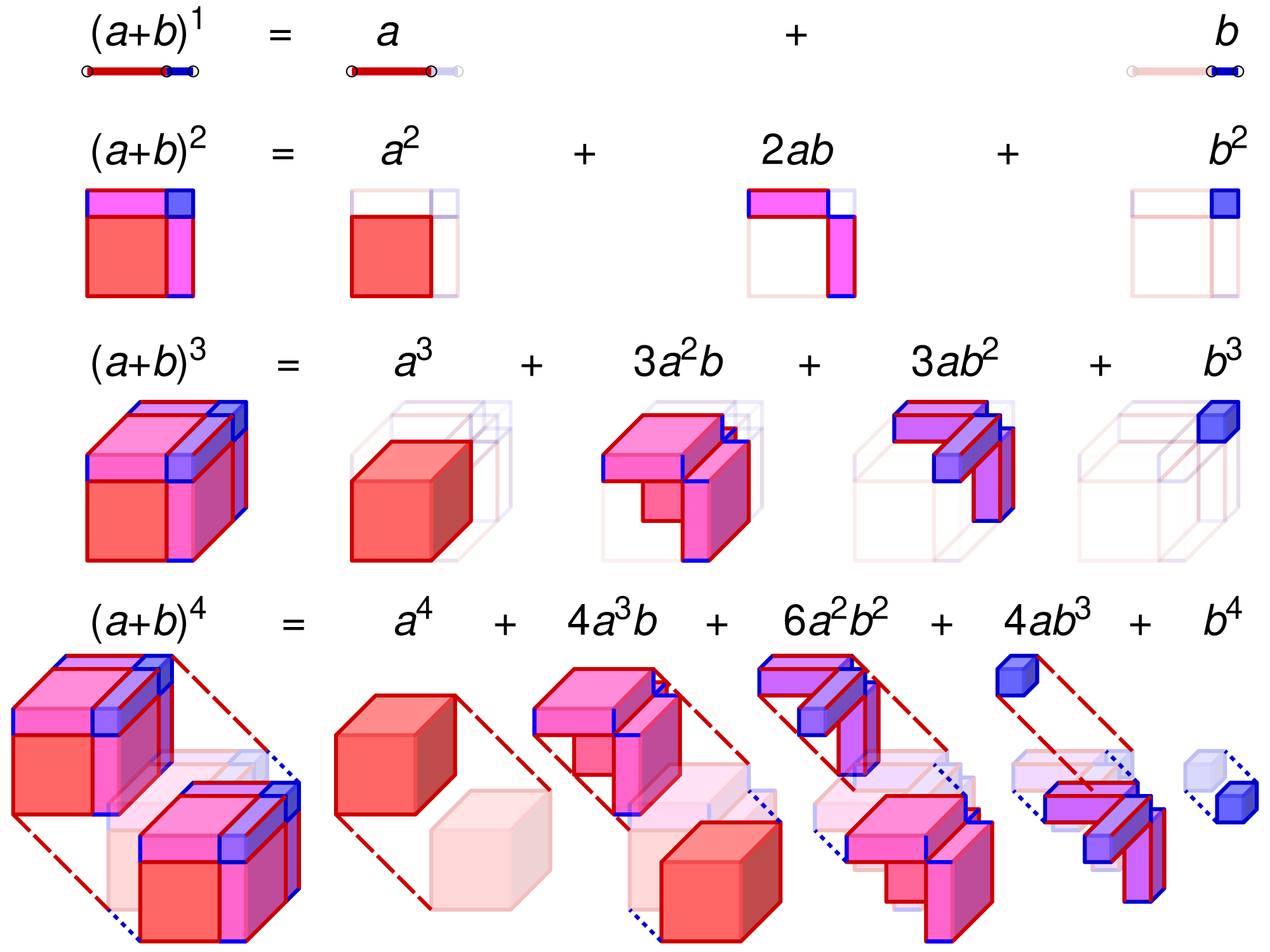
She had drawn precise points on her graph to represent (1,1) (2,4) (3,9)... on graph 1, and (1,2) (2,4) (3,6)... on graph 2. And when she said how quickly one was growing, I said "say more about that?" and I wrote out that pattern she describes -- the gaps were 1, 3, 5, 7, 9. "So this is what you mean by one grows faster and faster." I pointed this out and said "what this means, I think, is that 92^2 - 91^2 = 183!" And one student "got it" right away "You just add 91 and 92" and another student was able to say this: If you have this square (below) that is 92 x 92, and the gray one (91 x 91) the difference is the white squares on that edge: 91 + 92:

As often happens with my style of inquiry, there was a painful day in the weeds, trying to find a question and a way to make progress. Today was sunshine and insights. We connected the binomial theorem, geometry, derivatives of polynomials, Stokes' theorem (though not in so many words). We could link graphs to tables to geometries. Fantastic questions came up - like, REAL questions about the foundations of calculus (why can you say (dx)^2 is zero, but not dx? - how can you build up a volume from infinitely thin sheets?).
My most proud instructional moment was when I asked a question - essentially getting at the purposefully ill-defined question of WHY the derivative of x^2 (a square's area) is 2x (two sides of that square), and we were at a point where I thought someone would draw what you see in the second line below (we'd also thought about cubes and other things, and had sentences on the board stating their answers but no representations). So I asked for a representation - hoping for squares. But instead, a student carefully (OH SO CAREFULLY) drew two graphs on the board: x^2 and 2x and said how one was rising faster and faster, but not the other.
She had drawn precise points on her graph to represent (1,1) (2,4) (3,9)... on graph 1, and (1,2) (2,4) (3,6)... on graph 2. And when she said how quickly one was growing, I said "say more about that?" and I wrote out that pattern she describes -- the gaps were 1, 3, 5, 7, 9. "So this is what you mean by one grows faster and faster." I pointed this out and said "what this means, I think, is that 92^2 - 91^2 = 183!" And one student "got it" right away "You just add 91 and 92" and another student was able to say this: If you have this square (below) that is 92 x 92, and the gray one (91 x 91) the difference is the white squares on that edge: 91 + 92:

(That's actually a 92 x 92 square. Not the best use of my time.)
And another student explained it by saying that:
a^2 - b^2 = (a+b)(a-b). And since, in this case, a-b = 1, then a^2 - b^2 = a+b.
WHAT?! YAY! I wasn't anticipating that answer until I visited her group, and I loved it. So now we have these two representations on the board (I held off on her explanation until we had the physical/geometry explanation because I didn't want too much emphasis on crunching math to start our discussion).
And this left us with the question of why (a+b) and not (2a) (the derivative is 2x, not (x + x + dx)); I had them take it to 3d (half the class) and the other half work on the question of what would happen if we weren't looking at 91 --> 92 (or a + a + 1), but, instead, a dx, or maybe 91 --> 91.001.
The broader question behind this was: it is SO WEIRD to me that the derivative of x^n is n x^(n-1). That's just too cute to be coincidence. There has to be something going on here. And by the end we were tying it back to the binomial theorem.
In this, the moment of instructional fear happened as Lauren was taking 5 minutes to carefully draw the graphs of x^2 and 2x. And it is only because of my depth of content knowledge that I found this way forward - by attending to the gaps in her x^3 graph; of knowing that, with the diagrams on the board, someone will be able to connect those gaps to growing squares, and that - if the square/linear relationship is not "too cute to be coincidence" then surely being able to tell everyone what 92^2 - 91^2 is is too cute. (There are few calculus ideas that I know and love as much as this one - and it goes back to making stop-motion videos of things falling to think about what constant acceleration means.)
Wednesday, October 5, 2016
Calculus
I had some great serendipity in finding a new collaborator. I put in a white paper on a small, internal grant I'd like to propose -- the role of design and engineering in science/math teaching -- short story is that they can't fund me (I'm in Education and this is a grant for "science" faculty), but the paper fell in the lap of our associate dean of the College of Arts and Sciences, and he's a math professor and has been wondering about design in his classes and wanted to talk.
I was skeptical (I'm not sure why), but we met a while back and he's awesome. Really great questions for me on what I mean by "design" and making, and what kinds of things I'm interested in. We're cut from the same cloth.
So today I sat in on his class before we sat to think through possible 2-day-long "design" problems. Here's what we've got:
(1) - this is my favorite - look at a bunch of 2-d shapes and come up with ways of defining which is the most "circular" (maybe starting with a bunch of rectangles; then looking at a set of same-area regular polygons, etc). I felt like I could not be sure that this would touch on ideas from calculus, but I'm pretty sure that after a day of discussion, we'd get somewhere pretty interesting and for the next day we could have a map towards calculus-y ideas. It's probably best that we're not going with this one, because the landscape of possible directions seems vast and we have two days.
[how we got to that question: he said that what is coming next in class are max/min problems, so "you have a cylinder, what shape will hold the most volume for a given surface area"... and I said "what's kind of cool about that is that it's the shape that's closest to being a sphere will still being a cylinder..." and then I wanted to figure out what I really meant by that]
(2) why is the derivative of x^3 = 3x^2? -- I can think of a few ways I'd get at this, one is geometric (if a cube of side x grows, you're essentially adding three sides (of area = x^2) on it), one is more numerical (the gap between squares changes linearly: 1,3,5,7,9...; the gap between cubes changes quadratically - but less obvious to see...)
And the one we chose, which Doug came up with and is more specific a question than #2:
(3) why does the derivative of volume look like an area?
We're each going to take a stab at how we would approach this in class and in homework, then get back together to work out details. Kind of excited.
I was skeptical (I'm not sure why), but we met a while back and he's awesome. Really great questions for me on what I mean by "design" and making, and what kinds of things I'm interested in. We're cut from the same cloth.
So today I sat in on his class before we sat to think through possible 2-day-long "design" problems. Here's what we've got:
(1) - this is my favorite - look at a bunch of 2-d shapes and come up with ways of defining which is the most "circular" (maybe starting with a bunch of rectangles; then looking at a set of same-area regular polygons, etc). I felt like I could not be sure that this would touch on ideas from calculus, but I'm pretty sure that after a day of discussion, we'd get somewhere pretty interesting and for the next day we could have a map towards calculus-y ideas. It's probably best that we're not going with this one, because the landscape of possible directions seems vast and we have two days.
[how we got to that question: he said that what is coming next in class are max/min problems, so "you have a cylinder, what shape will hold the most volume for a given surface area"... and I said "what's kind of cool about that is that it's the shape that's closest to being a sphere will still being a cylinder..." and then I wanted to figure out what I really meant by that]
(2) why is the derivative of x^3 = 3x^2? -- I can think of a few ways I'd get at this, one is geometric (if a cube of side x grows, you're essentially adding three sides (of area = x^2) on it), one is more numerical (the gap between squares changes linearly: 1,3,5,7,9...; the gap between cubes changes quadratically - but less obvious to see...)
And the one we chose, which Doug came up with and is more specific a question than #2:
(3) why does the derivative of volume look like an area?
We're each going to take a stab at how we would approach this in class and in homework, then get back together to work out details. Kind of excited.
Friday, September 30, 2016
Ma
On my plate for the next week:
1 - IUSE grant - get letters of commitment to colleagues I'd like to be involved (Jess Watkins, Ayush Gupta, Brian?, Danielle?, Sam, Megan, Amy, IDoTeach)
2 - STEM night prep (I'm running a little demo/make-and-take in an elementary school)
3 - literature review for IC paper
So for #3:
Jasmine Ma has an article "Designing Disruptions for Productive Hybridity: The Case of Walking Scale Geometry" that I've just finished -- what I like from this: "Those who have investigated designs for hybridity have discovered some difficulties in bridging students’ out-of-school resources with classroom content"... and the solution, for Ma, is not to anticipate and develop instructional links to out-of-school resources, but to make "certain typical classroom resources ... explicitly unavailable...and so a setting is created in which it is reasonable and even necessary for students to draw from their nonclassroom repertoires of practice."
I think that's exactly what we do in Scientific Inquiry - but not even with any kind of radical disruption (e.g., doing "walking scale geometry" on a football field, as Ma does) - but just by getting rid of books and lab equipment.
My take-away from this article, though, is this: she's talking about how to design for other resources (other contexts) to be brought into the classroom. I'm highlighting the ways in which other contexts appear and why that should matter for transfer. So, in the end, I don't know that this is going to be too useful, except in a end-of-paper implications/next steps kind of way.
Nice quotes, though, are below... in case I want to use this later:
"Rather than bridging home or community funds of knowledge with school learning, I propose designing disruptions to typical school practices to invite students to recruit out-of-school resources meaningful and sensible to them in order to grapple with school-valued concepts..."
"I take a relational view of equity here that “sees issues of diversity as emerging from the relations between communities in which students participate rather than as characteristics of students and their communities” (Cobb & Hodge, 2002, p. 257). From this point of view, equitable instructional design takes into account the variety of ways in which students participate in local and broader communities, or their repertoires of practice (K. D. Gutiérrez & Rogoff, 2003), ensuring that all students have access to learning, not despite, but because of, their diverse repertoires of practice and histories of engagement in cultural practices. Tasks and instruction must be accessible in relation to the actual knowledge and experiences of students rather than some narrow, assumed set, and they should build on this knowledge and experience so that new concepts are sensible to students."
...In contrast to instructional tasks designed around known student practices, these disruptions invite students to engage with tasks in ways that make sense to them, making connections to diverse out-of-school practices."
Heteroglossia, or the multiple voices in a social space, can be acknowledged and fostered so that dialogic meanings can be negotiated and developed. These multiple voices include not just those of the individuals present but also the many identities and histories of experience participants may choose to present in an interaction. This is in contrast to monologic and authoritative meanings that can be imposed in classrooms and other settings by those in power positions (e.g., teachers).
Third spaces arise when unofficial spaces, in interaction with official spaces and discourses, are included and supported.
Studies that seek to promote hybridity specifically (e.g., González, Andrade, Civil, & Moll, 2001; K. D. Gutiérrez et al., 1999; Moje et al., 2004) and equitable learning settings in general typically treat student participation and engagement in three common ways (Enyedy & Mukhopadhyay, 2007; Lee, 2001; Rosebery, Ogonowski, DiSchino, & Warren, 2010). First, researchers and teachers take as assumed that diversity is a resource in teaching and learning and can be leveraged. They do this by incorporating typically invisible, undervalued, or marginalized student-centered resources into classroom activity. Second, students’ diverse contributions are actively invited and supported, whether they are discourse practices or other forms of funds of knowledge. Third, aspects of instruction—topics, participation structures, instructional strategies—are used to bridge school and out-of-school practices. ... The strategy described here, designing disruptions for productive hybridity, [incorporates the first two but] differs in that the designed setting is not meant to produce hybridity but to provide a setting to support it. By this I mean that designing disruptions does not provide bridges but instead opens up the learning environment to encourage students to build those bridges. I provide a rationale and a more detailed account of what this means in the next section.
Those who have investigated designs for hybridity have discovered some difficulties in bridging students’ out-of-school resources with classroom content...
Certain typical classroom resources are made explicitly unavailable through these disruptions, and so a setting is created in which it is reasonable and even necessary for students to draw from their nonclassroom repertoires of practice. I use the term setting deliberately to acknowledge that spaces are made up of built material features experienced in activity by individuals and groups (Lave, 1988; Lave, Murtaugh, & de la Rocha, 1984; Ma & Munter, 2014). Settings at once influence and are influenced by the activity that occurs within them. Thus, disrupting a setting disrupts both ongoing activity and how participants experience and understand the spaces of activity...
It can be struck as long as students are positioned with conceptual agency (Boaler & Greeno, 2000; Gresalfi & Cobb, 2006)—they must be active participants in the making and negotiation of meaning and inventing or selecting of strategies for problem solving, in part by recruiting resources of their choosing that may be unanticipated by or unfamiliar to the teacher or instruction designer.
In designing disruptions for productive hybridity, instructional designers replace existing settings with elements that disrupt some crucial infrastructure for learning or engaging in disciplinary activity. The disruption invites agentive student participation in hybrid learning activity in which students otherwise may have been held accountable, implicitly or explicitly, to cultural tools (e.g., representational forms, discursive norms) determined by the teacher or curricu- lum. In the WSG case representational forms and practices, shown to be highly consequential for the development of mathematical reasoning (Hall & Greeno, 2008; Lehrer & Lesh, 2003), was the target of disruption.
1 - IUSE grant - get letters of commitment to colleagues I'd like to be involved (Jess Watkins, Ayush Gupta, Brian?, Danielle?, Sam, Megan, Amy, IDoTeach)
2 - STEM night prep (I'm running a little demo/make-and-take in an elementary school)
3 - literature review for IC paper
So for #3:
Jasmine Ma has an article "Designing Disruptions for Productive Hybridity: The Case of Walking Scale Geometry" that I've just finished -- what I like from this: "Those who have investigated designs for hybridity have discovered some difficulties in bridging students’ out-of-school resources with classroom content"... and the solution, for Ma, is not to anticipate and develop instructional links to out-of-school resources, but to make "certain typical classroom resources ... explicitly unavailable...and so a setting is created in which it is reasonable and even necessary for students to draw from their nonclassroom repertoires of practice."
I think that's exactly what we do in Scientific Inquiry - but not even with any kind of radical disruption (e.g., doing "walking scale geometry" on a football field, as Ma does) - but just by getting rid of books and lab equipment.
My take-away from this article, though, is this: she's talking about how to design for other resources (other contexts) to be brought into the classroom. I'm highlighting the ways in which other contexts appear and why that should matter for transfer. So, in the end, I don't know that this is going to be too useful, except in a end-of-paper implications/next steps kind of way.
Nice quotes, though, are below... in case I want to use this later:
"Rather than bridging home or community funds of knowledge with school learning, I propose designing disruptions to typical school practices to invite students to recruit out-of-school resources meaningful and sensible to them in order to grapple with school-valued concepts..."
"I take a relational view of equity here that “sees issues of diversity as emerging from the relations between communities in which students participate rather than as characteristics of students and their communities” (Cobb & Hodge, 2002, p. 257). From this point of view, equitable instructional design takes into account the variety of ways in which students participate in local and broader communities, or their repertoires of practice (K. D. Gutiérrez & Rogoff, 2003), ensuring that all students have access to learning, not despite, but because of, their diverse repertoires of practice and histories of engagement in cultural practices. Tasks and instruction must be accessible in relation to the actual knowledge and experiences of students rather than some narrow, assumed set, and they should build on this knowledge and experience so that new concepts are sensible to students."
...In contrast to instructional tasks designed around known student practices, these disruptions invite students to engage with tasks in ways that make sense to them, making connections to diverse out-of-school practices."
Heteroglossia, or the multiple voices in a social space, can be acknowledged and fostered so that dialogic meanings can be negotiated and developed. These multiple voices include not just those of the individuals present but also the many identities and histories of experience participants may choose to present in an interaction. This is in contrast to monologic and authoritative meanings that can be imposed in classrooms and other settings by those in power positions (e.g., teachers).
Third spaces arise when unofficial spaces, in interaction with official spaces and discourses, are included and supported.
Studies that seek to promote hybridity specifically (e.g., González, Andrade, Civil, & Moll, 2001; K. D. Gutiérrez et al., 1999; Moje et al., 2004) and equitable learning settings in general typically treat student participation and engagement in three common ways (Enyedy & Mukhopadhyay, 2007; Lee, 2001; Rosebery, Ogonowski, DiSchino, & Warren, 2010). First, researchers and teachers take as assumed that diversity is a resource in teaching and learning and can be leveraged. They do this by incorporating typically invisible, undervalued, or marginalized student-centered resources into classroom activity. Second, students’ diverse contributions are actively invited and supported, whether they are discourse practices or other forms of funds of knowledge. Third, aspects of instruction—topics, participation structures, instructional strategies—are used to bridge school and out-of-school practices. ... The strategy described here, designing disruptions for productive hybridity, [incorporates the first two but] differs in that the designed setting is not meant to produce hybridity but to provide a setting to support it. By this I mean that designing disruptions does not provide bridges but instead opens up the learning environment to encourage students to build those bridges. I provide a rationale and a more detailed account of what this means in the next section.
Those who have investigated designs for hybridity have discovered some difficulties in bridging students’ out-of-school resources with classroom content...
Certain typical classroom resources are made explicitly unavailable through these disruptions, and so a setting is created in which it is reasonable and even necessary for students to draw from their nonclassroom repertoires of practice. I use the term setting deliberately to acknowledge that spaces are made up of built material features experienced in activity by individuals and groups (Lave, 1988; Lave, Murtaugh, & de la Rocha, 1984; Ma & Munter, 2014). Settings at once influence and are influenced by the activity that occurs within them. Thus, disrupting a setting disrupts both ongoing activity and how participants experience and understand the spaces of activity...
It can be struck as long as students are positioned with conceptual agency (Boaler & Greeno, 2000; Gresalfi & Cobb, 2006)—they must be active participants in the making and negotiation of meaning and inventing or selecting of strategies for problem solving, in part by recruiting resources of their choosing that may be unanticipated by or unfamiliar to the teacher or instruction designer.
In designing disruptions for productive hybridity, instructional designers replace existing settings with elements that disrupt some crucial infrastructure for learning or engaging in disciplinary activity. The disruption invites agentive student participation in hybrid learning activity in which students otherwise may have been held accountable, implicitly or explicitly, to cultural tools (e.g., representational forms, discursive norms) determined by the teacher or curricu- lum. In the WSG case representational forms and practices, shown to be highly consequential for the development of mathematical reasoning (Hall & Greeno, 2008; Lehrer & Lesh, 2003), was the target of disruption.
Thursday, September 29, 2016
With a can-do attitude, anything can be food.
So today in class ("perspectives"), I had us consider what kinds of things "decompose" - and had students develop taxonomies of decomposition and consider various ways of describing/naming their taxonomies. I handed out a stack of cards with items to sort/categorize: flour, sugar, salt, wood, virus, dead fish, gasoline, plastic bag, iron, bread, granite, water, chalk, helium, honey, fossils.
I was thinking about questions like:
- what, if anything, is the fundamental difference between burning and decomposing? between dissolving and decomposing? between rusting and decomposing? between digesting and decomposing? are these different to a biologist but not a chemist?
- what are things that burn well but don't decompose easily (e.g., gasoline, wax) - and what's the difference?
- why are some energy-dense molecules just not suitable for food?
- why do some foods not go in the fridge?
- do these taxonomies loosely align themselves with disciplines - the "food/decompose" things (biology), the earth sciences things that do rock-cycle things, the high energy scales of nuclear decomposition, etc. Does your discipline influence your taxonomies?
Some groups were just sorting "animal/vegetable/mineral" kinds of sorts without much cool conversation. At one table, they had a group labeled "food" and I asked about it -- and one student said, "With a can-do attitude, anything can be food." -- and this is actually a real question for me -- is that true? What ideas from physics, chemistry and biology can support us in answering that question? And it's also play - I loved the phrasing of it. So I took a moment to celebrate that question at the table, then wrote it on the board and brought it to the whole class (34 students) to note that this, to me, is actually one of the deeper questions underneath this sorting game. Can anything be food? and is gasoline "food" for a car?
Anyway, it seemed reminiscent of my post from yesterday - like I'm in a room of toddlers, looking for a way to frame this as a game - and so I wanted to share.
I was thinking about questions like:
- what, if anything, is the fundamental difference between burning and decomposing? between dissolving and decomposing? between rusting and decomposing? between digesting and decomposing? are these different to a biologist but not a chemist?
- what are things that burn well but don't decompose easily (e.g., gasoline, wax) - and what's the difference?
- why are some energy-dense molecules just not suitable for food?
- why do some foods not go in the fridge?
- do these taxonomies loosely align themselves with disciplines - the "food/decompose" things (biology), the earth sciences things that do rock-cycle things, the high energy scales of nuclear decomposition, etc. Does your discipline influence your taxonomies?
Some groups were just sorting "animal/vegetable/mineral" kinds of sorts without much cool conversation. At one table, they had a group labeled "food" and I asked about it -- and one student said, "With a can-do attitude, anything can be food." -- and this is actually a real question for me -- is that true? What ideas from physics, chemistry and biology can support us in answering that question? And it's also play - I loved the phrasing of it. So I took a moment to celebrate that question at the table, then wrote it on the board and brought it to the whole class (34 students) to note that this, to me, is actually one of the deeper questions underneath this sorting game. Can anything be food? and is gasoline "food" for a car?
Anyway, it seemed reminiscent of my post from yesterday - like I'm in a room of toddlers, looking for a way to frame this as a game - and so I wanted to share.
Wednesday, September 28, 2016
The nip denotes the bite
I'm taking a parent/toddler class on Monday mornings. Kate plays with 9 other 2 - 3 year olds behind a one-way mirror as the parent(s) discuss all things toddler with an early childhood expert for 90 minutes.
Kate is an easy-going kiddo (no siblings and in daycare for 8 hours a day), but there are lots of challenges coming up - moms home with two kids who may have sibling issues, or a little boy who just needs to punch things to get out some feelings, and so on. One thing the instructor often discusses when someone brings up a problem (yelling, throwing, hitting, refusing to do something, etc.) is "are they really ____ or are they just playing with that idea?" And a lot of her recommendations have to do with what I would call framing -- if it isn't really ferocious, say, but a testing of boundaries or a play for power -- she has techniques that are all about framing it as play. It's fascinating.
And it works! - My one issue that I brought up was that Kate will often refuse to walk and - if I don't carry her - she lies down in the middle of the parking lot, say. Maite (our teacher) suggested playing with this idea at a safe time -- if Kate refuses to get something or walk somewhere, I drop to the ground theatrically -- "OH, Kate, I CANNOT move my legs! Oh NO! Can you PLEEEASE help me?" I tried it (Kate was refusing to get something), and Kate giggled and giggled and then - theatrically - helped mommy. It was a game, and it was fun. She got to play at being in power, she got to explore the idea of not being carried. And we got the job done. I don't know how to measure it, but I would guess that, over time, she'd get to work out her concerns and feel confident not being carried and feel safe being a big kid who can get places by herself.
Listening to the advice Maite gives, I keep thinking of Bateson's "the nip denotes the bite, but it does not denote what the bite denotes." -- a theory of play (and puppies). And I think that so much of toddlerhood is puppy nips, and so much parenting missteps are to react to these nips as bites. Or maybe that the toddler doesn't yet quite know - is this play? is this dangerous? is this something I can explore? do I need to be brave here or can I just mess about? - and my job is to help frame it for her: yes, this is a game we can play, here's how we can make scary bites into playful nips so that we can explore. Toddlerhood is a pretty scary thing - having more power, feeling angry, competing with siblings, having new friendships, and being away from mom for longer stretches -- and framing our interactions to make these ideas *play* is part of my job (and her job, too - she's so good at it already, though).
And I think a lot about science -- we live in these imaginary/model worlds with our colleagues -- discussing invented objects (resonances, eigenvalues, energy states) -- and yet I don't think we do a good job framing classrooms as places of *play* -- science class is often so tied in with high stakes/evaluative kinds of activities that it can't feel like play, you have to be really brave all the time. (For one, college is just so expensive! - who has time to play?) And I do think some of what I do in a classroom is about framing the activity as play. (This is related to Luke Conlin's dissertation, I think.)
Also, the preschool is from the Bank Street model - which describes its approach ("developmental-interaction") as: "Developmental-Interaction refers to the ways in which cognition and emotion are always interconnected in any teaching situation. Meaningful content (provided by a teacher) and active relationships and collaborations with student peers and teachers provide the basis for learning. By closely observing the reactions, reflections, and interactions of students; by guiding with her own comments and questions; and by encouraging every ounce of student curiosity, the educator teaches her students." Love it.
Another last note: I'm thinking more about not only how we create places of play to reduce the need to be so brave all the time, but also how we create sacred spaces, too - places of ritual and sobriety and remind us that it's not all play, that allow us to feel how real it all is. - I think it's important to have both. (Not that play and sacred are opposites.)
Kate is an easy-going kiddo (no siblings and in daycare for 8 hours a day), but there are lots of challenges coming up - moms home with two kids who may have sibling issues, or a little boy who just needs to punch things to get out some feelings, and so on. One thing the instructor often discusses when someone brings up a problem (yelling, throwing, hitting, refusing to do something, etc.) is "are they really ____ or are they just playing with that idea?" And a lot of her recommendations have to do with what I would call framing -- if it isn't really ferocious, say, but a testing of boundaries or a play for power -- she has techniques that are all about framing it as play. It's fascinating.
And it works! - My one issue that I brought up was that Kate will often refuse to walk and - if I don't carry her - she lies down in the middle of the parking lot, say. Maite (our teacher) suggested playing with this idea at a safe time -- if Kate refuses to get something or walk somewhere, I drop to the ground theatrically -- "OH, Kate, I CANNOT move my legs! Oh NO! Can you PLEEEASE help me?" I tried it (Kate was refusing to get something), and Kate giggled and giggled and then - theatrically - helped mommy. It was a game, and it was fun. She got to play at being in power, she got to explore the idea of not being carried. And we got the job done. I don't know how to measure it, but I would guess that, over time, she'd get to work out her concerns and feel confident not being carried and feel safe being a big kid who can get places by herself.
Listening to the advice Maite gives, I keep thinking of Bateson's "the nip denotes the bite, but it does not denote what the bite denotes." -- a theory of play (and puppies). And I think that so much of toddlerhood is puppy nips, and so much parenting missteps are to react to these nips as bites. Or maybe that the toddler doesn't yet quite know - is this play? is this dangerous? is this something I can explore? do I need to be brave here or can I just mess about? - and my job is to help frame it for her: yes, this is a game we can play, here's how we can make scary bites into playful nips so that we can explore. Toddlerhood is a pretty scary thing - having more power, feeling angry, competing with siblings, having new friendships, and being away from mom for longer stretches -- and framing our interactions to make these ideas *play* is part of my job (and her job, too - she's so good at it already, though).
And I think a lot about science -- we live in these imaginary/model worlds with our colleagues -- discussing invented objects (resonances, eigenvalues, energy states) -- and yet I don't think we do a good job framing classrooms as places of *play* -- science class is often so tied in with high stakes/evaluative kinds of activities that it can't feel like play, you have to be really brave all the time. (For one, college is just so expensive! - who has time to play?) And I do think some of what I do in a classroom is about framing the activity as play. (This is related to Luke Conlin's dissertation, I think.)
Also, the preschool is from the Bank Street model - which describes its approach ("developmental-interaction") as: "Developmental-Interaction refers to the ways in which cognition and emotion are always interconnected in any teaching situation. Meaningful content (provided by a teacher) and active relationships and collaborations with student peers and teachers provide the basis for learning. By closely observing the reactions, reflections, and interactions of students; by guiding with her own comments and questions; and by encouraging every ounce of student curiosity, the educator teaches her students." Love it.
Another last note: I'm thinking more about not only how we create places of play to reduce the need to be so brave all the time, but also how we create sacred spaces, too - places of ritual and sobriety and remind us that it's not all play, that allow us to feel how real it all is. - I think it's important to have both. (Not that play and sacred are opposites.)
Tuesday, July 12, 2016
Teaching - blech.
Yesterday I wanted students to reason through this question:
if you have a belt snug around the earth at the equator, and then you lengthen it 6 feet and have it kind of "hover" over the earth, what can now fit between the earth and the belt? An amoeba? A cat? A horse? ... I find the answer (a cat) surprising. I think trying to articulate why that is so surprising, and then trying to figure out to make sense of the answer, a really interesting thing to do. The math, it seems to me, is simple enough that getting the answer isn't too hard. Articulating why it's surprising is a little harder - and a fun and useful thing to do in class. Since this is a class about knowing and learning, I thought this exercise - where we think about being able to do the math, and how that does not mean we understand the problem - would be a great start.
But it totally fell flat. Most students plugged into a formula, came up with "cat" and were like "yeah, huh. I might have guessed amoeba, but it's not...". And I didn't recover well. I spent a lot of time trying to convince them they should be surprised, and then trying to get them to articulate why they were surprised. Ugh.
Then today I had half the class to discuss this more (I had anticipated using today to talk through the 'how do we make sense of this?' and instead did more of a worksheet approach... it still didn't go so well...); I tried to use an example of how math that doesn't seem sensible (imaginary numbers) can be seen to make sense (terrible idea). And the last half of the class I wanted to set up the use of stop-motion animation. The prompt for stop motion was for all groups to create a video of something moving at constant speed -- slow and fast.
I didn't think about this needing more of a prompt, but clearly it did. Some people wrote out "hello" at constant speed, or drew a balloon at constant speed. Some took a video of something moving. Some used a string to simulate a snake. Some had a spinning pen. Another group had a coin zig-zagging - slowing and speeding up. One group used a ruler and a pen to have constant motion. I had anticipated videos being uploaded and us thinking through how "speed" gets represented here - but that was not to be. Again I just felt dumbstruck and unsure of where to go next.
I'm co-teaching and feeling just so sheepish about how it's going. How unprepared I feel and how it looks like I've just never met a preservice teacher. When I think of why teachers are nervous about teaching by inquiry, this is why.
if you have a belt snug around the earth at the equator, and then you lengthen it 6 feet and have it kind of "hover" over the earth, what can now fit between the earth and the belt? An amoeba? A cat? A horse? ... I find the answer (a cat) surprising. I think trying to articulate why that is so surprising, and then trying to figure out to make sense of the answer, a really interesting thing to do. The math, it seems to me, is simple enough that getting the answer isn't too hard. Articulating why it's surprising is a little harder - and a fun and useful thing to do in class. Since this is a class about knowing and learning, I thought this exercise - where we think about being able to do the math, and how that does not mean we understand the problem - would be a great start.
But it totally fell flat. Most students plugged into a formula, came up with "cat" and were like "yeah, huh. I might have guessed amoeba, but it's not...". And I didn't recover well. I spent a lot of time trying to convince them they should be surprised, and then trying to get them to articulate why they were surprised. Ugh.
Then today I had half the class to discuss this more (I had anticipated using today to talk through the 'how do we make sense of this?' and instead did more of a worksheet approach... it still didn't go so well...); I tried to use an example of how math that doesn't seem sensible (imaginary numbers) can be seen to make sense (terrible idea). And the last half of the class I wanted to set up the use of stop-motion animation. The prompt for stop motion was for all groups to create a video of something moving at constant speed -- slow and fast.
I didn't think about this needing more of a prompt, but clearly it did. Some people wrote out "hello" at constant speed, or drew a balloon at constant speed. Some took a video of something moving. Some used a string to simulate a snake. Some had a spinning pen. Another group had a coin zig-zagging - slowing and speeding up. One group used a ruler and a pen to have constant motion. I had anticipated videos being uploaded and us thinking through how "speed" gets represented here - but that was not to be. Again I just felt dumbstruck and unsure of where to go next.
I'm co-teaching and feeling just so sheepish about how it's going. How unprepared I feel and how it looks like I've just never met a preservice teacher. When I think of why teachers are nervous about teaching by inquiry, this is why.
Wednesday, June 22, 2016
PERC paper?
***
if you want to comment on the draft, best to look at the most up-to-date version, which is here:https://www.overleaf.com/read/zbknqjzvvvsg
***
I thought I'd take a few days to map out a possible PERC paper. The easier one to write is the one that maps out IC ... but I want that to fit into a longer journal paper. So I thought I'd try to frame a paper that looks at one class day through several lenses... showing how this class instantiates several themes, and doesn't others. After two solid days on this, I'm not sure it really holds together. It's just hard to fit it into four pages.
Below is the first two pages, leaving me < two pages to describe what unfolds in the 90 minutes of class, and how to see that through the various lenses I outlined...
Would love thoughts from anyone who has time!
I. INTRODUCTION
Physics Education Research has made great strides in improving students’ understanding of physics content by operationalizing "understanding" [1], creating curricula that promote gains in understanding [2], and developing common design principles for that curriculum [2]. However, this improved understanding is of little value if students do not draw on their knowledge outside of the classroom. And yet there is little research on whether or not students transfer ideas from physics classes to other settings, or the characteristics of instruction that promote that transfer.
This gap is the rationale behind the study reported here. Specifically, we have been interested in one type of transfer: moments in which students use science concepts to see and experience their "everyday" world in meaningful, new ways– a concept related to Pugh’s [3] construct of "transformative experience" (TE). In other papers we examine the measurement of TE [4, 5]. In this paper we address the question: what aspects of curriculum and instruction support high TE and transfer?
Below, we summarize research on characteristics of instruction that promote or inhibit transfer [6–8]. We then examine how those characteristics are instantiated in a physics classroom that has high TE scores [5]. In particular, we look across one day of instruction and link features of this classroom to hypothesized mechanisms that support transfer. Although we are reporting on a non-traditional course, we anticipate that these findings can lead to design principles to support learning that has relevance beyond the classroom walls.
II. BACKGROUND: LEARNING FOR TRANSFER
Early research on transfer has been conducted with scripted "training" and defined "target" scenarios [9]. In our study, we are interested in learning that takes place in the less-controlled setting of a classroom, and transfer as a choice to notice and use ideas from class in settings where it is not required or even anticipated. Despite the large literature on transfer, studies of this ilk - particularly in science - are few; we briefly summarize four strands of research below.
A. Pugh: teaching for transformative experiences
To teach for transformative experiences, Pugh notes that instructors should "create a context where particular ways of experiencing the world through concepts are displayed and valued and to help students come to participate more centrally in these experiences." (p 1106) To do this, a teacher should "(a) [frame] the content in terms of its experiential value, (b)[scaffold] re-seeing, and (c) [model] transformative experiences."
This approach, then, foregrounds the instructor’s role: noting for students how content has use and value, modeling how to see the world with these concepts, and scaffolding students in seeing the world in new ways. This stands in contrast to approaches described below, which attend to how classroom activity, rather than the content, is framed.
B. Greeno: accountable authors
In his preface to a journal issue on transfer, Greeno [7] hypothesizes that transfer happens, in part, when "...people learn how to act with conceptual agency in substantive domains and in activity settings, and authoritative and accountable positioning in learning environments facilitates that learning...If a student has developed a participatory identity with strong conceptual agency while learning concepts...we could expect that student to be more likely to participate with strong conceptual agency when he or she has an opportunity to use those concepts and methods in another setting."
If a student is to use physics ideas in interpreting the thickness of her reading glasses, that student must not only understand reflection and refraction, but have the conceptual agency to co-opt physics ideas to interpret novel scenarios. This departs from traditional models of transfer (which focus
on the role of content knowledge and the role of similarity between learning and transfer scenarios) to emphasize the importance of agency in using content. This contrasts, too, with Pugh’s approach, which could be interpreted as modeling and rehearsing conceptual agency, but without any explicit attention to constructing ideas as an accountable author as a way of achieving such agency.
C. Engle: expansive framing
Engle[6] also examines how students and content are positioned in a classroom that shows evidence of transfer. Her ideas echo Greeno, with an emphasis on accountable authorship, as well as Pugh, as she highlights that students "expect they will need to continue using what they have learned." In
addition, and drawing on controlled transfer studies that show similarities between "learning" and "transfer" contexts facilitate transfer, she argues that classes that "expansively frame" contexts so that "a larger encompassing context is formed that seamlessly incorporates learning and transfer contexts" will facilitate transfer.
In our discussion of a high-TE class, we will examine what such "expansive framing" looks like for this class and how it may support, or even problematize the idea of, transfer.
D. Engeström: overcoming encapsulation
Finally, we turn to research that examines "encapsulation," the opposite of transfer, where ideas from school are only used in school. Engeström[8] highlights one example: students have difficulty explaining the phases of the moon even after instruction. These misconceptions, he argues, "are not
indications of immature thinking. They are culturally produced artifacts..." In his Activity Theory analysis, he suggests that school activity is such that "the school text is the object of the activity instead of being an instrument for understanding the world." Students learn about the textbook, not the moon.
Engeström argues that to construct classrooms that are not encapsualted, one must shift towards expansive learning, where " learners construct a new object and concept for their collective activity, and implement this new object and concept in practice... Nobody knows exactly what needs to be
learned. The design of the new activity and the acquisition of the knowledge and skills it requires are increasingly intertwined" (Engeström, 1999a).
These implications are reminiscent of Greeno (students should be accountable authors of content) and of Engle (instead of a bounded context/text, there is an open - e.g., expansively framed - ’context of discovery’"). But for Engeström this is relevant not only because it provides students with conceptual
agency and reduces barriers for transfer, but because it will demand that the object of their inquiry is not an object particular to a school-setting, living in a textbook or relevant to Pasco equipment, but discovered by and relevant to students.
III. DATA AND METHODS
We have developed and implemented a survey on transformative experiences[4] and, from those results, identified a course with high TE: Scientific Inquiry. Briefly, this is a course for undergraduate pre-service elementary teachers; we have no textbook, lab manual or typical lab materials, but work in small gropus with everyday materials to model complex phenomena. We have frequent whole-class conversations as we develop consensus models [10]. The class is videotaped, student work is photographed, and the instructor maintains field notes. The course was designed to engage
students in inquiry, not transfer, nor was it based on the principles (described above) that promote transfer and TE.
Because the course shows high TE, we examine this course to see whether and how those principles are instantiated. For this paper, we have transcribed a relatively typical day: students began the course by examining a pinhole camera and constructing models to explain what they saw; they have nascent models for how light enters the pinhole to produce an inverted image. Students have recently questioned how the light reflects off of surfaces so that it enters the pinhole, and several groups have been experimenting to answer that question. The day begins with the instructor (the author) summarizing the class model, the problem that model raised (how light reflects), and current ideas that have been proposed to solve that problem, and then asking for additional ideas.
Below, we trace ideas and activity of the 100-minute class in light of the ideas of TTES, accountable authorship, expansive framing, and overcoming encapsulation.
Friday, June 10, 2016
Expansive framing and IC and transfer and THIRD SPACE?
One thing coming up for me as I work on the IC paper is this idea of "substantive" or "consequential" IC. Those terms feel fraught to me, and in a conversation with Angie yesterday I found the phrasing "IC in service of developing ideas" to seem less judgmental (normative?) - I want to say a bit more and see if anyone can help (or tell me if I sound like an ass):
But what I mean by this is: often the "cultural practices/knowledge" that are brought to bear are exemplified by Barton et al's paper:
It also reminds me of this: http://www.npr.org/sections/codeswitch/2013/08/08/207348197/science-rap-b-a-t-t-l-e-s-bring-hip-hop-into-the-classroom
Also, to be clear, this should "count" as science just as much as upper/middle class kids' science fair projects or worksheets or Prezi "research projects" or flashcards or whatever "count" as science in school settings. Kids are rewarded/praised/celebrated all the time for demonstrations of knowledge that are (to me) kind of goofy, and as long as what students are doing in science classrooms is this kind of weird schooly thing, then - by all means - let's let rap battles and Lou Bega songs be celebrated, too. And HOORAY for Ginny in finding a way to do something interesting and creative during flash-card-hour at school (and preserving her "hardworking and outgoing" identity nonetheless). And HOORAY for her teacher in letting her.
But I want to contrast that with what Johnny (bomb blasts) and Wendi (red oil paints) and Maddy (Walgreen's glasses) and Mary (bartending) and Rocio (salsa bowls bleaching in the sun) are doing.
The difference, to me, I think, is that their backgrounds / cultural practices / first-space lives are consequential for the ideas being developed in class. We are accountable to their experiences, ideas and skills from outside class (Johnny, Wendi, Rocio); our experiences in class are transforming their activity in out-of-school life (Maddy); and their knowledge from out-of-school can help us make sense of things we have trouble understanding (Mary).
The worry: it sounds a bit like "the things they bring into class are only "productive" if they are in the service of scientific Discourse." Which is why I think emphasizing the "in service of ideas..." or something - and being specific about what that means - might be important to do well.
Related to this (I've been starting to read some "third space" things):
"third space" seems to be something to contrast with expansive framing. - is “third space” ever construed expansively — like Engle — that is encompasses first and second spaces, rather than being a bridge/link/etc. between the two spaces? The TE survey shows us that students pursue these ideas at home, with friends, at work, while shopping... in this way, all these spaces look like "third space" and so "expansive framing" might be a more useful way to think about ideas that are usually part of "third space" kinds of things. (But I know so little about this literature, I'm not sure.)
But what I mean by this is: often the "cultural practices/knowledge" that are brought to bear are exemplified by Barton et al's paper:
During one of the concluding lessons on the skeletal system, the teacher instructed the students to make flash cards of the key terms describing the skeletal system in order to prepare for the end-of-unit test. Ginny, an outgoing and hardworking student, made her required stack of flashcards. Upon completing her flashcards, she also began to write a song about the skeletal system to the melody and lyrics of “Mambo #5” ...
Ginny was highly successful on the skeletal system test, scoring 95%. Four months later when we interviewed her about her experiences in science, she could still perform the entire bone song and dance...
The bone song also illustrates how signature science artifacts served as resources for entering into the science classroom discourse community with positions of authority without having to assimilate into the normative culture of the science classroom. Ginny could be a singer and dancer and invest these dimensions in her science learning in a way that positioned her as someone central to the classroom science community, as was evident in the role her song played in all five sections of 6th-grade science. With the bone song, Ginny’s nontraditional resources for doing science were validated and integrated into the everyday talk of her classroom and 6th-grade science at her school.To me, it seems like those (being a singer and dancer) are not used as resources for "doing science" - it seems to me that they're used as resources for "doing school" (finding ways to commit terms to memory for a test). It would be as if my student, Wendi, who is an artist, uses her skills and knowledge in art to paint a homework assignment.
It also reminds me of this: http://www.npr.org/sections/codeswitch/2013/08/08/207348197/science-rap-b-a-t-t-l-e-s-bring-hip-hop-into-the-classroom
Also, to be clear, this should "count" as science just as much as upper/middle class kids' science fair projects or worksheets or Prezi "research projects" or flashcards or whatever "count" as science in school settings. Kids are rewarded/praised/celebrated all the time for demonstrations of knowledge that are (to me) kind of goofy, and as long as what students are doing in science classrooms is this kind of weird schooly thing, then - by all means - let's let rap battles and Lou Bega songs be celebrated, too. And HOORAY for Ginny in finding a way to do something interesting and creative during flash-card-hour at school (and preserving her "hardworking and outgoing" identity nonetheless). And HOORAY for her teacher in letting her.
But I want to contrast that with what Johnny (bomb blasts) and Wendi (red oil paints) and Maddy (Walgreen's glasses) and Mary (bartending) and Rocio (salsa bowls bleaching in the sun) are doing.
The difference, to me, I think, is that their backgrounds / cultural practices / first-space lives are consequential for the ideas being developed in class. We are accountable to their experiences, ideas and skills from outside class (Johnny, Wendi, Rocio); our experiences in class are transforming their activity in out-of-school life (Maddy); and their knowledge from out-of-school can help us make sense of things we have trouble understanding (Mary).
The worry: it sounds a bit like "the things they bring into class are only "productive" if they are in the service of scientific Discourse." Which is why I think emphasizing the "in service of ideas..." or something - and being specific about what that means - might be important to do well.
Related to this (I've been starting to read some "third space" things):
"third space" seems to be something to contrast with expansive framing. - is “third space” ever construed expansively — like Engle — that is encompasses first and second spaces, rather than being a bridge/link/etc. between the two spaces? The TE survey shows us that students pursue these ideas at home, with friends, at work, while shopping... in this way, all these spaces look like "third space" and so "expansive framing" might be a more useful way to think about ideas that are usually part of "third space" kinds of things. (But I know so little about this literature, I'm not sure.)
Wednesday, June 1, 2016
Latest progress, next steps
1 - I'm really getting into the paper I'm working on, though I think it is by writing that I have a paper to write, so there is a lot of revising ( = starting over? ) in my future. One argument that's coming out is what it means for the intercontextuality to be scientifically substantive. I'm fleshing out arguments about how these moments don't just "expand" the context of what we're doing but actively contribute to the science we are doing. Wendi, an artist, does not just use paints to demonstrate an idea in a novel way, but her knowledge of paints contributes to and pushes back on our ideas about color. I think this pushes a little against some work in hybrid spaces -- where students bring their cultural practices into a science class but in ways that feel a bit weak to me. I think this matters for TE/transfer.
2 - But that's on hold right now as I finish book edits -- it's fun to see someone professionally edit your writing. Who knew I used "foreground" as a verb in every single chapter?! And I think I'm sparing with the comma, but she keeps cutting. She also added comments where she loved what we had to say, and boy does that make me feel good. :) (NOTE FOR FUTURE IRB: include permission to publish students' work and students' faces. I have permission to share video online, but not publish faces.) I'm so proud of this book.
3 - A local parent emailed asking about "Science Circles" to partner with existing "Math Circles" that exist at Boise State. I'm really excited and want to start sketching out a plan and possible grant ideas. https://www.mathcircles.org (I'm really really excited!! - definitional work? color work? involving parents? TE work? thinking about engineering? so much cool stuff to do here, and a way of reaching students I don't usually reach.)
4 - I'm an external reviewer for a tenure case of someone I don't know. It's nerve wracking - so much is at stake for someone I don't know, and I wish I had more context.
5 - I'm planning two classes - one to start in July and one to start in August. Both will be fun to teach, and I get to co-teach with some really great math ed folks. (I'll be taping (as always) but these are currently less connected to my research. But I can imagine a paper coming out of one of these.)
6 - as part of that, I'm getting to read some great books on math/science/engineering history, and I would like a month at the beach with frooty drinks and daycare to get that reading done. Anyone want to come watch a toddler all day every day for a month?? (More likely: good nighttime reading.) One math ed colleague wants to start a book club with these books.
7 - AERA? NARST? I haven't presented at either before on my own (I was part of something others did back in the pre-faculty days). I might be picking brains of colleagues soon on what/how to put together a proposal. Angie is coming out in a few weeks and hopefully will help with these ideas, too!
8 - Longer term: I hope to start up my Science Inquiry class for elementary ed again in a year or so. This is totally possible, I think, and I'd like to include some engineering and computer science ideas. Our dean in Engineering is so open to new ideas and would let me teach there. I want to pick the brains of folks like Ayush and Brian Danielak.
9 - I don't exercise and I need to, but there so many other things I'd rather do.
10 - After a weekend away, I'm committed to doing lots more travel (NOT including conference travel or holiday visits home). I want a week in a fun European city this fall with my little family, and I want a long weekend camping in the Sawtooths, too.
2 - But that's on hold right now as I finish book edits -- it's fun to see someone professionally edit your writing. Who knew I used "foreground" as a verb in every single chapter?! And I think I'm sparing with the comma, but she keeps cutting. She also added comments where she loved what we had to say, and boy does that make me feel good. :) (NOTE FOR FUTURE IRB: include permission to publish students' work and students' faces. I have permission to share video online, but not publish faces.) I'm so proud of this book.
3 - A local parent emailed asking about "Science Circles" to partner with existing "Math Circles" that exist at Boise State. I'm really excited and want to start sketching out a plan and possible grant ideas. https://www.mathcircles.org (I'm really really excited!! - definitional work? color work? involving parents? TE work? thinking about engineering? so much cool stuff to do here, and a way of reaching students I don't usually reach.)
4 - I'm an external reviewer for a tenure case of someone I don't know. It's nerve wracking - so much is at stake for someone I don't know, and I wish I had more context.
5 - I'm planning two classes - one to start in July and one to start in August. Both will be fun to teach, and I get to co-teach with some really great math ed folks. (I'll be taping (as always) but these are currently less connected to my research. But I can imagine a paper coming out of one of these.)
6 - as part of that, I'm getting to read some great books on math/science/engineering history, and I would like a month at the beach with frooty drinks and daycare to get that reading done. Anyone want to come watch a toddler all day every day for a month?? (More likely: good nighttime reading.) One math ed colleague wants to start a book club with these books.
7 - AERA? NARST? I haven't presented at either before on my own (I was part of something others did back in the pre-faculty days). I might be picking brains of colleagues soon on what/how to put together a proposal. Angie is coming out in a few weeks and hopefully will help with these ideas, too!
8 - Longer term: I hope to start up my Science Inquiry class for elementary ed again in a year or so. This is totally possible, I think, and I'd like to include some engineering and computer science ideas. Our dean in Engineering is so open to new ideas and would let me teach there. I want to pick the brains of folks like Ayush and Brian Danielak.
9 - I don't exercise and I need to, but there so many other things I'd rather do.
10 - After a weekend away, I'm committed to doing lots more travel (NOT including conference travel or holiday visits home). I want a week in a fun European city this fall with my little family, and I want a long weekend camping in the Sawtooths, too.
Friday, May 20, 2016
To Do List for Writing Retreat
I'm going away for three days to get lots of writing done!
My goals:
(1) a literature review on TE as a kind of transfer. What is TE? What has Pugh (et al) said about the relationship between TE and transfer? and check out the Jornet, roth, etc. and Nemirovsky articles in drafting this review.
(2) a literature review on transfer (see above) that does not include TE
(3) a literature review on IC
If time, or if I need to switch gears:
- more IC coding.
Other goals:
I have a nice list of history-of-___ (STEM topic) books to review for the fall. So I can read good books recommended by friends at night. I AM SO EXCITED.
My goals:
(1) a literature review on TE as a kind of transfer. What is TE? What has Pugh (et al) said about the relationship between TE and transfer? and check out the Jornet, roth, etc. and Nemirovsky articles in drafting this review.
(2) a literature review on transfer (see above) that does not include TE
(3) a literature review on IC
If time, or if I need to switch gears:
- more IC coding.
Other goals:
I have a nice list of history-of-___ (STEM topic) books to review for the fall. So I can read good books recommended by friends at night. I AM SO EXCITED.
Thursday, May 12, 2016
Blogging Goldstone & Wilensky
Okay - I read Goldstone and Wilensky (R. L. Goldstone and U. Wilensky, J. of the Learning Sc. 17, 465 (2008)) and got to feeling a little blue because it does what I want to do but better. I told Angie I'd blog about it and -- voila -- not so blue!
Here's the major difference between what they do and what I think the IC paper could do:
- G&W are interested in a kind of transfer that involves "seeing" complex systems formalisms/ generalizations across disparate domains. Students develop some powerful ideas around complex systems (e.g. what "positive feedback" is) in one idealized but concrete scenario; in doing so they can now "see" this in other complex systems. They have a lovely description of the "flexible perception of similarity" which I love and does, I think, connect.
- I am interested - or at least noticing - that what students "transfer" is often not a generalization or a set of principles, but, instead, "activity." - They share ideas with peers, notice things that are brought into class, continue experiments when appropriate, wonder about new phenomena, etc. Some reasons for this difference in our focus is that, in the inquiry class, we build towards "principles" (or "rules of light") but they often don't exist for quite some time. It's also something that is not widely applicable to other (non-light) phenomena, the way that complex systems principles are. On the other hand, it is applicable to a LOT of phenomena. (And Janeal mentioned thinking about the 'shadow' of water.)
One thing I want to take-away from G&W has to do with the determination of "near" v. "far" -- and I think that Engle does this, too: similarity is a flexible idea; so, too, is near- and far- transfer. Intercontextuality turns "far" transfer into "near" transfer or even not transfer at all. Maddy at Walgreens, for example. Are those two ideas (similarity and transfer dimensions) something I could link?
Some quotes and thoughts from the paper...
1. They begin with the idea of a "grounded generalization" --
p.467: Instead [of formalisms], we propose learning and teaching methods that promote situation construals that are concrete insofar as they are perceptually, temporally, and spatially grounded. However, they are still idealizations in that many elements of a situation are ignored or highly simplified. In this article, our argument for how to achieve grounded generalizations involves the following steps: (1) Describe the nature of complex systems accounts of science, (2) provide examples of general complex systems principles that appear in several case studies, (3) describe pedagogical benefits of teaching science through complex systems, (4) discuss the importance of transfer and generalization in relation to complex systems, (5) present a method for achieving generalization through perceptually grounded yet interpreted simulations, and (6) compare generalization from grounded simulations to formalism-centered strategies and other methods for achieving transfer.
Me: I think we begin with a particular, puzzling problem that lends itself to "idealizations:" how the eye works, the pinhole theater, color. But we do not begin with the idealization. I often quote Polya "there's an easier problem you can solve. Find it." -- and these "easier" problems are idealizations (a single lens with a single bulb) of the more complex problem.
2. They argue for the "why" of attention to complex systems:
p. 472: The principles of complex systems are naturally applicable in many, often seemingly unrelated, situations. This is because the principles are expressed in generic terms such as element, agent, resource, inhibition, excitation, interactions, connection, motion, force, neighbor, energy, and strength.
? is that true?
Me: I argue for something that is ubiquitous, too, but not at the level of "principles" or other abstractions, but at the level of phenomenon: light, color, eyes, sound, astronomy (moon, sun) are the kinds of things you will interact with across your life ... I think this is probably also true of complex systems, but it's a slightly different argument.
3. "STRATEGIES FOR PROMOTING TRANSPORTABLE UNDERSTANDINGS"
Here I think is a big difference between the usual discussion of "transfer" and what I'm interested in and noticing with my class: my students, I would say, are "thinking about" these ideas all the time, but not in a way that I would call "transportable understandings." That is, when I look at Andy, Maddy, the "haunts you" comments -- I think what is "transporting" is "activity" of some sort -- noticing, talking, wondering, etc., and not (always, usually?) "understanding." So much of our class is mired in NOT understanding and cultivating curiosity.
4. LOVE THIS
p. 478: "In their own published research, mathematicians tend to provide formal proofs but not the visuospatial inspiration for the proofs. This has led mathematicians to complain that the true heart of the proof, the intuitive conceptualization, is ignored in the formal description of the proof steps themselves (Hadamard, 1949). The scholarly articles contain the step-by-step, formally sanctioned steps, but if one wishes to understand where the idea for these steps comes from, then one must attempt to generate the underlying idea oneself, without much insight from the published report. The exterior face of mathematics is presented without revealing the skeleton that is the source of the fa- cial structures. This tendency to hide the conceptual structure has spread from the research to educational mathematical community."
... and then he goes on to cite my favorite Lakoff & Nunez. love. and yet I can't figure out if what follows is critique or not??
5. The Flexible Perception of Similarity
This, I think, is so closely related to the dissertation I wrote ... and makes me a little sad about my lack of publications!...
"An important plank of our proposal is that the similarity between situations governed by the same complex systems principle can be used to promote transfer even if the situations are dissimilar to the untutored eye, and even if the similarity is not explicitly noticed. This claim apparently contradicts the empirical evidence for very limited transfer between remote situations (Detterman, 1993; Reed, Ernst, & Banerji, 1974; but see also Barnett & Ceci, 2002, for a balanced evaluation of the evidence). In fact, our claim is that the perceived similarity of situations is malleable, not fixed by objective properties of the situations themselves."
"One reason why skeptics doubt remote transfer is because of a focus on analytic and explicit transfer. It may be difficult to get people to analytically bring to mind previously learned schemas (Gick & Holyoak, 1983). Instead, we propose to teach people ways of looking at situations that become natural perceptual habits. When we say looking, we mean perception, but we also mean using representations to encode situations—just as telescopes and microscopes extend perception, so cognitive technologies [like Agent Based Modeling? is this a technology or a "cognitive technology"?] can extend perception by giving people representations that extend their abilities to encode situations. diSessa and Sherin (1998) also emphasized the importance of perceptual shifts for achieving conceptual change and argued that these shifts may be both perceptual and interpretational: “In many instances this seeing is a substantial accomplishment of learning and will depend only very partially on basic perceptual capabilities” (p. 1172). In this extended sense of perceptual learning, acquiring diagramming techniques such as Euler Circles for logic, Cayley diagrams for group theory, and Feynman diagrams for quantum field theory are all methods for changing perception so that it becomes sensitive to otherwise obscure and esoteric properties of a situation."
Here's the major difference between what they do and what I think the IC paper could do:
- G&W are interested in a kind of transfer that involves "seeing" complex systems formalisms/ generalizations across disparate domains. Students develop some powerful ideas around complex systems (e.g. what "positive feedback" is) in one idealized but concrete scenario; in doing so they can now "see" this in other complex systems. They have a lovely description of the "flexible perception of similarity" which I love and does, I think, connect.
- I am interested - or at least noticing - that what students "transfer" is often not a generalization or a set of principles, but, instead, "activity." - They share ideas with peers, notice things that are brought into class, continue experiments when appropriate, wonder about new phenomena, etc. Some reasons for this difference in our focus is that, in the inquiry class, we build towards "principles" (or "rules of light") but they often don't exist for quite some time. It's also something that is not widely applicable to other (non-light) phenomena, the way that complex systems principles are. On the other hand, it is applicable to a LOT of phenomena. (And Janeal mentioned thinking about the 'shadow' of water.)
One thing I want to take-away from G&W has to do with the determination of "near" v. "far" -- and I think that Engle does this, too: similarity is a flexible idea; so, too, is near- and far- transfer. Intercontextuality turns "far" transfer into "near" transfer or even not transfer at all. Maddy at Walgreens, for example. Are those two ideas (similarity and transfer dimensions) something I could link?
Some quotes and thoughts from the paper...
1. They begin with the idea of a "grounded generalization" --
p.467: Instead [of formalisms], we propose learning and teaching methods that promote situation construals that are concrete insofar as they are perceptually, temporally, and spatially grounded. However, they are still idealizations in that many elements of a situation are ignored or highly simplified. In this article, our argument for how to achieve grounded generalizations involves the following steps: (1) Describe the nature of complex systems accounts of science, (2) provide examples of general complex systems principles that appear in several case studies, (3) describe pedagogical benefits of teaching science through complex systems, (4) discuss the importance of transfer and generalization in relation to complex systems, (5) present a method for achieving generalization through perceptually grounded yet interpreted simulations, and (6) compare generalization from grounded simulations to formalism-centered strategies and other methods for achieving transfer.
Me: I think we begin with a particular, puzzling problem that lends itself to "idealizations:" how the eye works, the pinhole theater, color. But we do not begin with the idealization. I often quote Polya "there's an easier problem you can solve. Find it." -- and these "easier" problems are idealizations (a single lens with a single bulb) of the more complex problem.
2. They argue for the "why" of attention to complex systems:
p. 472: The principles of complex systems are naturally applicable in many, often seemingly unrelated, situations. This is because the principles are expressed in generic terms such as element, agent, resource, inhibition, excitation, interactions, connection, motion, force, neighbor, energy, and strength.
? is that true?
Me: I argue for something that is ubiquitous, too, but not at the level of "principles" or other abstractions, but at the level of phenomenon: light, color, eyes, sound, astronomy (moon, sun) are the kinds of things you will interact with across your life ... I think this is probably also true of complex systems, but it's a slightly different argument.
3. "STRATEGIES FOR PROMOTING TRANSPORTABLE UNDERSTANDINGS"
Here I think is a big difference between the usual discussion of "transfer" and what I'm interested in and noticing with my class: my students, I would say, are "thinking about" these ideas all the time, but not in a way that I would call "transportable understandings." That is, when I look at Andy, Maddy, the "haunts you" comments -- I think what is "transporting" is "activity" of some sort -- noticing, talking, wondering, etc., and not (always, usually?) "understanding." So much of our class is mired in NOT understanding and cultivating curiosity.
4. LOVE THIS
p. 478: "In their own published research, mathematicians tend to provide formal proofs but not the visuospatial inspiration for the proofs. This has led mathematicians to complain that the true heart of the proof, the intuitive conceptualization, is ignored in the formal description of the proof steps themselves (Hadamard, 1949). The scholarly articles contain the step-by-step, formally sanctioned steps, but if one wishes to understand where the idea for these steps comes from, then one must attempt to generate the underlying idea oneself, without much insight from the published report. The exterior face of mathematics is presented without revealing the skeleton that is the source of the fa- cial structures. This tendency to hide the conceptual structure has spread from the research to educational mathematical community."
... and then he goes on to cite my favorite Lakoff & Nunez. love. and yet I can't figure out if what follows is critique or not??
5. The Flexible Perception of Similarity
This, I think, is so closely related to the dissertation I wrote ... and makes me a little sad about my lack of publications!...
"An important plank of our proposal is that the similarity between situations governed by the same complex systems principle can be used to promote transfer even if the situations are dissimilar to the untutored eye, and even if the similarity is not explicitly noticed. This claim apparently contradicts the empirical evidence for very limited transfer between remote situations (Detterman, 1993; Reed, Ernst, & Banerji, 1974; but see also Barnett & Ceci, 2002, for a balanced evaluation of the evidence). In fact, our claim is that the perceived similarity of situations is malleable, not fixed by objective properties of the situations themselves."
"One reason why skeptics doubt remote transfer is because of a focus on analytic and explicit transfer. It may be difficult to get people to analytically bring to mind previously learned schemas (Gick & Holyoak, 1983). Instead, we propose to teach people ways of looking at situations that become natural perceptual habits. When we say looking, we mean perception, but we also mean using representations to encode situations—just as telescopes and microscopes extend perception, so cognitive technologies [like Agent Based Modeling? is this a technology or a "cognitive technology"?] can extend perception by giving people representations that extend their abilities to encode situations. diSessa and Sherin (1998) also emphasized the importance of perceptual shifts for achieving conceptual change and argued that these shifts may be both perceptual and interpretational: “In many instances this seeing is a substantial accomplishment of learning and will depend only very partially on basic perceptual capabilities” (p. 1172). In this extended sense of perceptual learning, acquiring diagramming techniques such as Euler Circles for logic, Cayley diagrams for group theory, and Feynman diagrams for quantum field theory are all methods for changing perception so that it becomes sensitive to otherwise obscure and esoteric properties of a situation."
Friday, May 6, 2016
"rehearsal space" ? paper
My writing group colleagues have been suggesting a practitioner paper. I have some ideas about how that might go...
The genius of Newton’s first law — “an object in motion stays in motion unless…” is that it tells us where to put our attention when trying to explain motion. If an object does not change its speed, there is no “why” — there is nothing to explain — that’s just what objects do. What begs explanations is why something changes its speed. That's when you can start poking around and finding forces responsible.
A similar thing, perhaps, could be said of transfer: “a student will transfer ideas across space and time unless…”. In this way, the thing to understand about the problem of transfer is why this thing that is so common in our everyday lives, as we are forever encountering novel situations and transferring prior learning to make sense of them, is so rare in classrooms and in psychology studies. While many researchers attend to things we can do to facilitate transfer, it may be worthwhile to examine the things school settings do that limit transfer.
To some degree, I believe, this has been answered in Engestrom’s account of the “encapsulation” of school learning, describing how students’ learning of the phases of the moon is not, in fact, about the moon at all — but about understanding and interpreting the textbook. The characteristics of traditional classrooms: a single age group, textbooks, the walls, the desks, the chairs, the lone teacher at the front, the tests, the discourse structures (IRE, say), the “lab” equipment (a graduated cylinder when a cup measure would do; a triple beam balance when a kitchen scale would work, etc.), the attention to problems that are never part of everyday ponderings (a ball rolling down a ramp, the pH of some solution, measuring the index of refraction) — are all characteristics of school and school only. If we wanted to limit transfer, we would do well to send someone to school.
If we want to encourage transfer, then, to me, this means that we want to set up an environment that encourages intercontextuality: where conversations look like those you might have in an out-of-class setting, where the roles you take on are ones you can imagine using in other environments, where the materials you use are perhaps repurposed, but are the kinds of things you find in a range of contexts, where the problems are ones that exist outside of school, and where the ways of talking feel like your "own" ways of talking in other settings.
One way of thinking about a classroom, particularly if what you're after is "transfer," is that the classroom is a rehearsal space for later activity. And, as with any good dress rehearsal, the more you can make the classroom similar to the transfer context -- in as many ways possible -- the better. In the theater, a dress rehearsal will attend to things like lighting, props, costumes, timing, maybe even a small audience of friends and family. What would a "rehearsal space" of a classroom look like? ...
The challenge, I think, is how to make that continuous with "science." Though science may be nothing more than "the refinement of everyday thinking" (Einstein and Hammer), it is in that refinement that science becomes a separate kind of thing. Continuous with is not synonymous with.
The genius of Newton’s first law — “an object in motion stays in motion unless…” is that it tells us where to put our attention when trying to explain motion. If an object does not change its speed, there is no “why” — there is nothing to explain — that’s just what objects do. What begs explanations is why something changes its speed. That's when you can start poking around and finding forces responsible.
A similar thing, perhaps, could be said of transfer: “a student will transfer ideas across space and time unless…”. In this way, the thing to understand about the problem of transfer is why this thing that is so common in our everyday lives, as we are forever encountering novel situations and transferring prior learning to make sense of them, is so rare in classrooms and in psychology studies. While many researchers attend to things we can do to facilitate transfer, it may be worthwhile to examine the things school settings do that limit transfer.
To some degree, I believe, this has been answered in Engestrom’s account of the “encapsulation” of school learning, describing how students’ learning of the phases of the moon is not, in fact, about the moon at all — but about understanding and interpreting the textbook. The characteristics of traditional classrooms: a single age group, textbooks, the walls, the desks, the chairs, the lone teacher at the front, the tests, the discourse structures (IRE, say), the “lab” equipment (a graduated cylinder when a cup measure would do; a triple beam balance when a kitchen scale would work, etc.), the attention to problems that are never part of everyday ponderings (a ball rolling down a ramp, the pH of some solution, measuring the index of refraction) — are all characteristics of school and school only. If we wanted to limit transfer, we would do well to send someone to school.
If we want to encourage transfer, then, to me, this means that we want to set up an environment that encourages intercontextuality: where conversations look like those you might have in an out-of-class setting, where the roles you take on are ones you can imagine using in other environments, where the materials you use are perhaps repurposed, but are the kinds of things you find in a range of contexts, where the problems are ones that exist outside of school, and where the ways of talking feel like your "own" ways of talking in other settings.
One way of thinking about a classroom, particularly if what you're after is "transfer," is that the classroom is a rehearsal space for later activity. And, as with any good dress rehearsal, the more you can make the classroom similar to the transfer context -- in as many ways possible -- the better. In the theater, a dress rehearsal will attend to things like lighting, props, costumes, timing, maybe even a small audience of friends and family. What would a "rehearsal space" of a classroom look like? ...
The challenge, I think, is how to make that continuous with "science." Though science may be nothing more than "the refinement of everyday thinking" (Einstein and Hammer), it is in that refinement that science becomes a separate kind of thing. Continuous with is not synonymous with.
Friday, April 29, 2016
Students' rights to their own ideas
This thought was much more profound on my bike ride this morning... I'm having a hard time getting the ideas down!
Let me see if I can get the ideas back:
one of the things I really took away from Kim's class on English composition was this idea that students have the right to their own ideas. "Students will write well only when they speak in their own voice, and that voice can only be authoritative and honest when the students speaks of his own concerns in his own way." (Murray 1974/1982, p. 129) It's easy to see how this might play out in an analysis of Hamlet, say, but it's harder to find space for students' rights to their own ideas in physics. I believe firmly in this -- and it doesn't (!!) mean students should not be introduced/grapple with/try to understand canonical ideas, their peers' ideas, others' data. But it means that this is in service of their own ideas. (Echoes of the split task from Elby/McCasky come to mind.)
Why do we see IC in the inquiry class and why do we see such ownership and TE-like things with definitional workshops? I think it *has* to be related to the fact that students have the right to their own ideas -- they are not being asked to justify someone else's (Newton's, Merriam Webster) idea with someone else's (Pasco's) data. And it's not a ploy -- we're not "guiding" them to Newton's or Merriam Webster's ideas; we genuinely allow them to have their own ideas.
Tangent:
I was watching "Making of a Murderer" in which a low-IQ teenager offers a (presumably) false confession to a horrific crime (and implicates his uncle of the more horrific murder). When watching the interrogation tapes, I just see my most horrible classroom moments play out in front of me - IRE at its worst - in which you are required to parrot back an idea from the teacher and you're hopelessly guessing what that idea might be. And the interrogators keep giving hints to push him along to the "right" answer.
In a much later scene, the child's mother asks why he lied and he says something to that effect - it's an absolutely chilling indictment of IRE/schooly discourse - "why would you say something that isn't true?" - him (essentially - I'd have to re-watch to find the transcript): "it's just what I do in school."
Another tangent:
... not to make too big a leap, but I've been trying to make sense of Trump in this way: what makes language "politically correct" and not just "correct"? -- I think it's something similar -- you're no longer afforded the right to your own moral compass. We describe something as "politically correct" to signify that it's not *actually* correct when we go home and close the doors and talk frankly (surely there's some great linguistic scholarship on this point... I'm sure my idea isn't new). When ideas of social justice are "politically correct" to a great number of people (as opposed to just "correct"), then you have a bunch of people feeling disenfranchised in our larger moral conversation. And when Trump comes along and, essentially, says the thing you've felt that you weren't allowed to say -- well, that can feel refreshing. (To those of us who found the "politically correct" ideas to be "correct" he sounds like a terrifying bigot.)
Let me see if I can get the ideas back:
one of the things I really took away from Kim's class on English composition was this idea that students have the right to their own ideas. "Students will write well only when they speak in their own voice, and that voice can only be authoritative and honest when the students speaks of his own concerns in his own way." (Murray 1974/1982, p. 129) It's easy to see how this might play out in an analysis of Hamlet, say, but it's harder to find space for students' rights to their own ideas in physics. I believe firmly in this -- and it doesn't (!!) mean students should not be introduced/grapple with/try to understand canonical ideas, their peers' ideas, others' data. But it means that this is in service of their own ideas. (Echoes of the split task from Elby/McCasky come to mind.)
Why do we see IC in the inquiry class and why do we see such ownership and TE-like things with definitional workshops? I think it *has* to be related to the fact that students have the right to their own ideas -- they are not being asked to justify someone else's (Newton's, Merriam Webster) idea with someone else's (Pasco's) data. And it's not a ploy -- we're not "guiding" them to Newton's or Merriam Webster's ideas; we genuinely allow them to have their own ideas.
Tangent:
I was watching "Making of a Murderer" in which a low-IQ teenager offers a (presumably) false confession to a horrific crime (and implicates his uncle of the more horrific murder). When watching the interrogation tapes, I just see my most horrible classroom moments play out in front of me - IRE at its worst - in which you are required to parrot back an idea from the teacher and you're hopelessly guessing what that idea might be. And the interrogators keep giving hints to push him along to the "right" answer.
In a much later scene, the child's mother asks why he lied and he says something to that effect - it's an absolutely chilling indictment of IRE/schooly discourse - "why would you say something that isn't true?" - him (essentially - I'd have to re-watch to find the transcript): "it's just what I do in school."
Another tangent:
... not to make too big a leap, but I've been trying to make sense of Trump in this way: what makes language "politically correct" and not just "correct"? -- I think it's something similar -- you're no longer afforded the right to your own moral compass. We describe something as "politically correct" to signify that it's not *actually* correct when we go home and close the doors and talk frankly (surely there's some great linguistic scholarship on this point... I'm sure my idea isn't new). When ideas of social justice are "politically correct" to a great number of people (as opposed to just "correct"), then you have a bunch of people feeling disenfranchised in our larger moral conversation. And when Trump comes along and, essentially, says the thing you've felt that you weren't allowed to say -- well, that can feel refreshing. (To those of us who found the "politically correct" ideas to be "correct" he sounds like a terrifying bigot.)
Thursday, April 28, 2016
Situated cognition for physicists.
Greeno, Moore & Smith (1993) describing situated cognition:
"... knowing is not an invariant property of an individual, something that he or she has in any situation. Instead, knowing is a property that is relative to situations, an ability to interact with things and other people in various ways. An analogy with physics seems helpful. Physicists recognize that motion is not a property of an object. The description of a moving object in terms of speed, direction, and acceleration depends fundamentally on a frame of reference. It is not enough to say that the frame of reference influences the motion -- in fact, saying that is quite misleading. Rather, the property that we refer to as motion is a relation between an object and a frame of reference, and it makes no sense to try to characterize motion except with reference to a frame. Similarly, it may not suffice to say that cognition is influenced by contexts. In the view of situated cognition, we need to characterize knowing, reasoning, understanding and so on as relations between cognitive agents and situations, and it is not meaningful to try to characterize what someone knows apart from situations in which the person engages in cognitive activity."I love that.
Wednesday, April 27, 2016
Rich questions and IC
I'm combing through data to find good clips with IC. Since I wasn't attending to this in the moment, it's a bit hard, and I'm relying on field notes that mostly just attended to the developing narrative of ideas. The first two that have jumped out as richly IC are:
(1) When you hear someone in the next room, is sound traveling through the wall, or is sound making the wall vibrate, and you're actually hearing the wall?
(2) If light reflects from an object and radiates out in all directions, why doesn't it look like objects are glowing? (Alyssa asks after Darcy notes that this idea - the rays going out in all directions - just doesn't feel right but she can't say why.)
One thing I like about these questions -- and something that might help promote IC -- is how complex they are. These are not simple "collect-some-data" questions. We can't answer them with a reference to one observation. They're not questions that I think all scientists would answer the same way. (Maybe the second, but I can imagine many different ways of answering that to get at the same idea.) In the second question, someone talks about her experience in dance when one person is on stage under a spotlight. (I later bring up the moon appearing to glow.)
They're also student-generated, but I promote them - the second, in particular, is not picked up on in the conversation about light fragmenting off of objects, and I bring it back up as a reason why we might not believe that idea.
Anyway, it makes me think about how much the questions matter for promoting rich IC (that is, for eliciting ideas that draw on a range of experiences from outside of the science-class context). That's kind of a "duh" observation, but it would be interesting, perhaps, to consider the questions that frame students' work in a class with low TE.
Sunday, April 24, 2016
One teaching implication message I don't want to forget
If we want to teach for TE/transfer to out of class, lived experience, we would do well to focus our instruction (particularly early on, at the intro level of K-12 or freshman courses?) on topics that lend themselves to TE: those that have broad scope not in the scientific disciplines per se (as the NGSS/crosscutting concepts would have you do), but those that are woven throughout our everyday lives; those for which IC is already a given based on the topic. I remember a conversation (with Andrew B perhaps?) about what you'd teach if you could - like, what's the most important thing to teach - and to me, it's the moon. Because of all the physics I've learned, that one (and the motion of the sun) never leaves me. I can never see the moon and not think about what I know and how I learned it. I still remember Rachel Scherr asking me pre-test questions -- like, "here's a picture of the moon, what time is it?" and I thought "sure. 'Here's a ham sandwich, what year is it?'" it seemed so impossible to answer that question. And now, every time I see the moon, I think about what time it is, where it is, whether it's waxing or waning, where the sun is.
I think the reason the moon does this for me and not, say, forces (which, of course, are also everywhere) is how the moon answers the same question (where's the sun?) over and over again in the same way. You often can't answer a force question -- just too much going on. But the moon's motion is so very knowable. (Pugh uses evolution, which is more like 'forces' to me than it is like the moon.) It's a little puzzle, but one you can always answer. Like the easy crossword. I love to do the Monday crossword.
This is why I think light, shadows, color, and other perceptual topics are important. But the moon is my favorite of all.
From biology, the carbon cycle is something I find myself always thinking about and just in love with, too.
I think the reason the moon does this for me and not, say, forces (which, of course, are also everywhere) is how the moon answers the same question (where's the sun?) over and over again in the same way. You often can't answer a force question -- just too much going on. But the moon's motion is so very knowable. (Pugh uses evolution, which is more like 'forces' to me than it is like the moon.) It's a little puzzle, but one you can always answer. Like the easy crossword. I love to do the Monday crossword.
This is why I think light, shadows, color, and other perceptual topics are important. But the moon is my favorite of all.
From biology, the carbon cycle is something I find myself always thinking about and just in love with, too.
Saturday, April 23, 2016
Outline of an IC paper
My writing group talked through some of this stuff on IC and thinks this is a paper. (They also suggest, in the future, looking at this from a CHAT perspective and that of "figured worlds." And are eager to see a practitioner paper, too.) I left feeling pretty good. Thanks, writing group.
Next steps are to figure out how to approach the data. I'll sketch out my imagined paper, then play with the data, and then come back to see if this sketch still holds.
The argument:
I'm interested in transfer, not transfer to later educational settings, but transfer that is captured by TE -- in which students "use" their science learning in their everyday lives. Engle proposes that transfer is fostered through expansive framing: situating students' work in a broader context. Expansive framing fosters intercontextuality (IC) which "fosters transfer between the linked learning and transfer contexts." And so one way to get high TE is through high IC, particularly IC that blends the learning and transfer (everyday) contexts.
And so I'm interested in two things: (1) can we find evidence of IC in classes with high TE, and (2) is that IC one that blends in-class and out-of-class contexts? (as opposed to Engle's study, which primarily blends past and future contexts.) In looking for IC, I can play with several ways in which we interpret "context" -- so to start, I'll be seeing if B&C's paper on dimensions of transfer can help articulate dimensions along which IC seems to happen in class. But more broadly, articulate other dimensions, particularly those that are relevant for TE.
Data:
show rich examples of IC in the Inquiry class, selected from memory, notes, and other transcribed sections, and discuss the ways in which it is intercontextual, looking in particular at B&C's framework, but also showing how limited that is in capturing real-world IC.
A possible second step (for a long paper) or a second paper?:
Look at how students describe their moments of TE and see how/whether those are consistent with the IC moments found in class. And when we consider the 202B example (beard...), we can see why they might not have high TE.
A second paper, I think, would be the following:
how does this specifically relate to "framing" -- that is, how is IC achieved in this class?
Engle notes: "When enough links between learning and transfer contexts are made, the degree of intercontextuality can get so strong that a larger encompassing context is formed that seamlessly incorporates learning and transfer contexts (see Step 4 in bottom of Figure 1; Greeno et al., 1993). As a result, further transfer is promoted (Step 5). In contrast to transfer after specific links are made between learning and transfer contexts (Step 3), this time learners are not aware that they are transferring anything as to them they are simply continuing to use the same relevant knowledge within the same (larger) context (Greeno et al., 1993; Lave, 1988; LCHC, 1983)." -- I think Maddy's Walgreen's story speaks to that - students do not see this necessarily as transfer.
"We believe that there are several different aspects of learning contexts that can be framed to affect transfer. This article focuses on framing that is expansive versus bounded with respect to settings and roles." -- I'm going to look for other aspects, beginning with B&C.
(side thought: reading Gee & Michaels and the kids whose narrative practices are reflected in school and those whose narrative practices are not reflected in school ... we could say that, for the upper class white kid, narrative practices are IC and for the African American kid, they are not... just another form of IC I probably won't be identifying in my data -- because I don't know how -- but something to think about)
Next steps are to figure out how to approach the data. I'll sketch out my imagined paper, then play with the data, and then come back to see if this sketch still holds.
The argument:
I'm interested in transfer, not transfer to later educational settings, but transfer that is captured by TE -- in which students "use" their science learning in their everyday lives. Engle proposes that transfer is fostered through expansive framing: situating students' work in a broader context. Expansive framing fosters intercontextuality (IC) which "fosters transfer between the linked learning and transfer contexts." And so one way to get high TE is through high IC, particularly IC that blends the learning and transfer (everyday) contexts.
And so I'm interested in two things: (1) can we find evidence of IC in classes with high TE, and (2) is that IC one that blends in-class and out-of-class contexts? (as opposed to Engle's study, which primarily blends past and future contexts.) In looking for IC, I can play with several ways in which we interpret "context" -- so to start, I'll be seeing if B&C's paper on dimensions of transfer can help articulate dimensions along which IC seems to happen in class. But more broadly, articulate other dimensions, particularly those that are relevant for TE.
Data:
show rich examples of IC in the Inquiry class, selected from memory, notes, and other transcribed sections, and discuss the ways in which it is intercontextual, looking in particular at B&C's framework, but also showing how limited that is in capturing real-world IC.
A possible second step (for a long paper) or a second paper?:
Look at how students describe their moments of TE and see how/whether those are consistent with the IC moments found in class. And when we consider the 202B example (beard...), we can see why they might not have high TE.
A second paper, I think, would be the following:
how does this specifically relate to "framing" -- that is, how is IC achieved in this class?
Engle notes: "When enough links between learning and transfer contexts are made, the degree of intercontextuality can get so strong that a larger encompassing context is formed that seamlessly incorporates learning and transfer contexts (see Step 4 in bottom of Figure 1; Greeno et al., 1993). As a result, further transfer is promoted (Step 5). In contrast to transfer after specific links are made between learning and transfer contexts (Step 3), this time learners are not aware that they are transferring anything as to them they are simply continuing to use the same relevant knowledge within the same (larger) context (Greeno et al., 1993; Lave, 1988; LCHC, 1983)." -- I think Maddy's Walgreen's story speaks to that - students do not see this necessarily as transfer.
"We believe that there are several different aspects of learning contexts that can be framed to affect transfer. This article focuses on framing that is expansive versus bounded with respect to settings and roles." -- I'm going to look for other aspects, beginning with B&C.
(side thought: reading Gee & Michaels and the kids whose narrative practices are reflected in school and those whose narrative practices are not reflected in school ... we could say that, for the upper class white kid, narrative practices are IC and for the African American kid, they are not... just another form of IC I probably won't be identifying in my data -- because I don't know how -- but something to think about)
Wednesday, April 20, 2016
modality IC
I think "intercontextual modality" has a name, and that's "multimodal."
Transfer:
Modality. The final dimension of transfer context, modality also has both macro- and microaspects. At the macrolevel, the task can be visual or auditory, written or verbal, linguistic or hands-on (e.g., model building), and so on. At the microlevel, a task can be in multiple-choice format or essay format, and so on. (It is possible that participants might, e.g., apply training to check their work by reviewing choices in a multiple-choice format but not transfer the skill to a less structured essay format.)
IC:
When students engage in a topic in multimodal ways - talking and writing ("macro") or, I guess, writing on their paper and writing on a whiteboard ("micro").
So when a student is talking and then turns to the board to write it; when a student is drawing a model and then goes home and builds it (HDB/spaghetti); when they share ideas on the whiteboard from their homework; when they comment on a reading in the margins with ideas we've talked about in class, when Carlie supports her claims with drawing from her notebook during a class discussion.
(This is the least interesting of the dimensions, I think, but it might be nice to show that the examples that students give of TE are usually either talk or simply noticing/wondering to themselves. And in many traditional courses, those are not primary ways of constructing knowledge.)
Transfer:
Modality. The final dimension of transfer context, modality also has both macro- and microaspects. At the macrolevel, the task can be visual or auditory, written or verbal, linguistic or hands-on (e.g., model building), and so on. At the microlevel, a task can be in multiple-choice format or essay format, and so on. (It is possible that participants might, e.g., apply training to check their work by reviewing choices in a multiple-choice format but not transfer the skill to a less structured essay format.)
IC:
When students engage in a topic in multimodal ways - talking and writing ("macro") or, I guess, writing on their paper and writing on a whiteboard ("micro").
So when a student is talking and then turns to the board to write it; when a student is drawing a model and then goes home and builds it (HDB/spaghetti); when they share ideas on the whiteboard from their homework; when they comment on a reading in the margins with ideas we've talked about in class, when Carlie supports her claims with drawing from her notebook during a class discussion.
(This is the least interesting of the dimensions, I think, but it might be nice to show that the examples that students give of TE are usually either talk or simply noticing/wondering to themselves. And in many traditional courses, those are not primary ways of constructing knowledge.)
social IC
social context transfer:
“This dimension refers to whether the task is learned and performed alone or in collaboration with others. A skill acquired in a group setting might not be equally well applied when alone or vice versa...although there is an extensive separate literature dealing with collaborative learning ..., it is not well integrated with the transfer work. In their National Research Council report, Druckman and Bjork (1994) stated, “Little empirical attention has been given [in the collaborative learning literature] . . . to transfer to other tasks” (p. 12).”
social intercontextuality:
This seems like a very narrow consideration of what might matter in terms of social context. In most every psych study of transfer you’re going to have an asker and an answerer. (Researcher and participant.) And the participant might have learned in another context (where they were in a social group, say.) But in more naturalistic settings, you’ll have someone positioned as a student in one setting, as a bartender in another, as a husband, a peer, a colleague, etc. So I might look for times in which there is a blend of “social roles” — student and parent, student and soldier, student and bartender, etc.
Examples:
So for IC, I would want take the example of Steven’s slide/heat/mirror and say this is *not* social IC. He learned this as a student in a lab class, and he’s using this knowledge as a student in a lab class. (Though, presumably, his knowledge of slides getting hot in the sun was learned as a kid on a playground.) Whereas Mary’s bartending example would be social IC, and Andy’s wife example would be social IC.
functional context IC
functional context transfer:
“Functional context. The function for which the skill is positioned and the mind-set it evokes in the individual can be referred to as the functional context... is it positioned as an academic activity or one belonging to the “real world” outside academia? Is the transfer task explicitly a test, or is it embedded in some daily activity? Problem-solving tools learned and encoded for one purpose might not transfer equally well to another. This dimension is conceptually related to the notion of functional fixedness (Duncker, 1945), in which the use of tools is tied to their original purpose.”
examples B&C give are a fake household survey used as the transfer test - not only was the location different, but the purposes/mind-set should be different, too. And transfer of a skill in horse racing to the stock market: "The participants’ handicapping skill, devel- oped while gambling real money on horse races, served a very different function in their lives than the artificial transfer task [stock market analysis] posed by the experimenters."
…
functional context IC:
For "functional context intercontextuality," we would see a blending of "purposes" or "functions." A breaking of "functional" fixedness for either a physical or a conceptual object.
this is a bit harder - how is this IC and not "transfer"? For other examples, the two scenarios are overlapping: we talk about another time, place, or knowledge domain in the Inquiry class. But here, I think it would be the mingling of purposes?
I guess I can think about it this way: if everyday (or other contexts') objects are used in science class (physical IC) we could be just swapping out a graduated cylinder for a measuring cup, a magnifying glass for a microscope (which would be, more or less, just physical IC -- a weak functional IC?). Or we could be doing a repurposing: using a spoon (which happened to be in class for breakfast) as a mirror, a yellow cooler as a test case for color (this would be both physical IC and functional IC).
And if ideas from other classes are used in science class (knowledge domain IC), we could be using them in a very similar way (energy conservation is used to explain mirrors as absorbers), or in a very different way (Mary and bartending: she has a lot of knowledge about how to mix drinks and she’s using that to interpret color mixing).
What about Daniel and the Japanese precision walkers? He refers to these when we discover that light does not affect light - two beams just pass right through each other. He uses these to interpret/explain what light is doing.
Temporal context IC
temporal context transfer:
the elapsed time between training and testing phases
temporal context intercontextuality:
in many cases, examples of IC will entail some temporal IC: when students invoke other events and places, they are necessarily thinking about other times. So all examples for those IC’s are also temporal IC. One way in which temporal context IC is distinct is for events that are not IC in any other way: do students actively refer back to earlier moments in class?
(can relate this to Engle expansive framing)
could consider our homework and how we use this in class as temporal IC
context: yesterday’s work influences tonight’s homework which will influence tomorrow’s activities
Thursday, Oct. 14th, 2010:
students are trying to make sense of orange and what "unlocks" different color cones, and I note “the data they were throwing around - colorblind cases, pixels on a computer screen, the venn diagram of color, mixing paints, newton’s experiment - the idea that if it wasn’t a haze, we would see rainbows with lines (and, I might add, just three lines?)”
clearly multiple ideas from multiple class periods and homework are coming up.
Physical context intercontextuality
physical context transfer:
Both macroaspects, such as whether the training and transfer phases are conducted at school, in a research lab, in the home environment, and so on, and microaspects, such as whether the exact same room is used and whether the experimenter is the same, make up the physical context.
physical context intercontextuality:
here we are not comparing two physical spaces: students are physically in the classroom. The question is whether or not they invoke other physical places. Is everything they do and use and discuss part of the classroom and lab environment? Or are they referring to outside places? Here we consider macroaspects: are they describing school, home, playground, mall, etc. and also microaspects: are they using/discussing objects that are usually part of those spaces, even if they are not discussing those spaces more explicitly?
Macro examples:
Steven’s example (CITE) invokes knowledge from another class (NSCI 141 / PSET), but he also thinks about that in the context of a playground slide getting hot in the sun. Contexts: this class, PSET class, and playground.
When wondering about why we don’t see a beam from a flashlight, Dee & Amanda compare this to the casino lights near their homes which are visible. (They develop a “ricochet” kind of theory that light in enclosed spaces interferes with the beam.) Contexts: this class and their home/community.
When we find out that light passes through light without disturbing the original beams, Daniel says that it is like “Japanese precision walkers” and we watch the video. Contexts: this class, an internet movie.
When wondering about color, Rocio mentions that her mother puts salsa bowls in the sunshine to bleach them. Contexts: this class, home.
When trying to understand why red is such a poor color to mix to make new colors, we entertain a “strength” theory — red is somehow stronger than other colors. And Emma mentions that bulls being attracted to red colors as one example of the “strength” of red. Contexts: this class, ranch.
When considering how so many different colors can be mixed from just three primaries, Mary compares this to bartending recipes that don’t vary the kinds of ingredients but the amounts. Contexts: this class, job (at a bar).
Question someone raised: does sound travel through a wall? Or does it push the wall and what you hear on the other side is the wall’s sound?
Johnny: I kind of both - agree with both sides, because the - sound does go through the sound does travel does go through like for example like a bomb blast or something you can, you can feel the vibration come-
Maria: And hear.
Johnny: Yeah. You can hear it - of course...You can even feel it- I mean, when it when it hits you it's like somebody punching you in the chest and then and it even go - you feel it go right through you.
Emma: So it's kind of like a bullet.
Johnny: It's it's a little bit different from a bullet, I mean, ...if there's grass you can see the grass you can see the grass kind of move all the way up until right in front of you. And then when it hits you, it it just like I said it's like somebody just hittin' you right in the chest. And it it hits you and then, y'know, if it's strong enough you can even you can even see you clothes just kind of flutter back it kind of pushes you back. And this is from being far away. so .
Megan: When did you get hit by a bomb?
Johnny: I I sh- I shot ah, a rocket launcher, so, an' it it exploded, it was like yards away and I still felt it. That's that's why I saw all the grass move and everything and it came up.
Mary: Was everybody okay?
Context: this class, army
Micro examples:
Alanna uses a spoon to investigate curved mirrors (object: spoon)
Kiki uses her eye glasses as a kind of lens (object: eyeglasses)
Gregoria brings in jell-o to model the vitreous humor (object: jell-o)
students use iPhone screens to examine primary colors of light (object: iPhone)
in modeling diffuse reflection, Daniel describes it as a “half-disco ball” (obect: disco ball)
exam uses a photo of a "ritz cracker" imaging an eclipse (object: Ritz cracker)
Subscribe to:
Posts (Atom)