Friday, March 30, 2012
AAPT or PERC?
Question for colleagues -- what makes something an "AAPT" abstract and what makes something a "PERC" abstract? I tend to always submit to PERC, and think of AAPT as more 'show and tell' / curriculum dissemination than research presentations. Is that a distinction others make?

Wednesday, March 28, 2012
PERC Outline
The writing group needs something to read and so I'm up. (Way to go writing group for keeping me on my toes... and my papers ungraded...)
Here's what I've got so far...
Representing Energy for a Physics of Processes & Causation
Abstract. Representations in physics not only offer a means of communicating ideas about the physical world, but they can prescribe - to some degree - the very nature of ideas we have about the physical world: the patterns we notice and the explanations that we offer for those patterns (cite). For example, in a study comparing the use of algebraic notations and programming languages in physics instruction, Sherin (1995) concluded “algebra-physics can be characterized as a physics of balance and equilibrium, and programming-physics a physics of processes and causation” (p. 421). Building on Sherin’s work, this paper describes a set of representations that, similar to “programming-physics,” embed energy in a physics of processes and causation. This is contrasted with standard “bookkeeping” representations of energy which embed energy in a physics of conservation. Implications and future research are discussed.Introduction
As part of an ongoing professional development and research effort, instructors and participants in Energy Project at SPU have developed novel representations for energy. Among the representations that have emerged from this work are the related representations of Energy Theater, Energy Cubes and Energy Tracking Diagrams [1,2]—here referred to as energy tracking representations (ETRs). Briefly, these dynamic or quasi-dynamic representations track units of energy in a system—representing these units with people, cubes or letters, respectively—as they transform from one form of energy to another and transfer location from one object to another.During the Summer 2011 professional development course for secondary science teachers, returning teachers familiar with these representations began relating energy transfers and transformations with forces. Through this effort, the teachers developed a set of “laws” for energy transfers and transformations—laws that, when taken together, build towards a description of the work-energy theorem[3].
As part of a research effort to understand the development of mechanistic ideas about energy, the author sought to establish the relationship between the laws the teachers generated and a mathematical description of the work-energy theorem. In doing so, it was noticed that, instead of articulating an equivalence between work and energy, e.g. the symmetric relationship


While this may not be surprising at first glance— introductory physics texts describe the work/energy relationship as a causal one, after all—the teachers’ causal language stands in contrast to observations of student ideas in introductory physics. Here students often treat the relationship between work and energy as one of numerical equivalence. That is, many students interpret the theorem as conveying: the quantity F.d is the same as the quantity Delta-KE, rather than Delta-KE is caused by F.d. Or, as McDermott & Lawson note [5]: “students often fail to treat the work-energy theorem… as a cause-effect relation. Instead, many treat it like a mathematical identity.”
Below, I will argue that:
1. Causal reasoning about energy is profoundly scientific, despite occasional claims to the contrary.
2. The teachers’ language around energy transfers and transformations was deeply causal. And,
3. The time-ordered nature of events in ETRs supported this “physics of causation.”
Implications for research and instruction will then be discussed.
Thursday, March 22, 2012
Symbolic forms & energy theater (& vacation)
I'm on vacation now - sitting in a rocking chair on a porch in Hawai'i staring at a blue blue ocean and happily thinking about work. I've alternatively felt guilty for this (is this evidence that I'm a workaholic?) and happy for this (is this evidence that I really love my work?). I've been trying not to respond to emails and blog posts, and mostly happy with that decision - because while it's professionally rewarding to imagine my blog audience hanging out with me while I teach, it's perhaps not socially rewarding to imagine my blog audience hanging out with me while I'm on a beach with my sweetheart. (No offense.)
I guess I wonder: to the degree that I think about work when I'm away from work, does that mean that I (a) am never wholly present expect when I'm at work? or (b) find my work to be such a rich, rewarding and transformative experience that it permeates my social and recreational life?
Anyway. I did bring work-related things with me, so in between swimming and hiking and picnics on beaches, buying fresh fish and drinking fruity drinks, I've been reading Sherin's dissertation. In it he compares students in an algebra-based physics course and students in a programming-based physics course (not entirely true - b/c the programming students had 2 quarters, I think?, of algebra-based physics, too). I wound up reading this because Hunter recommended one of Sherin's papers that discusses the "equal sign" and then after reading this, there's some indication that the equal sign doesn't convey/represent causality, so I went on to read the dissertation.
Sherin's dissertation (The Symbolic Basis of Physical Intuition: A Study of Two Symbol Systems in Physics Instruction):
Anyway, it's made me think that energy theater is much closer to a programming representation of energy than it is to algebraic representation of energy. And because of that, it is causal in a way the algebraic descriptions aren't. And looking at Sherin's work comparing algebra and programming might give some insights in how to understand the representation/symbol systems of Energy Theater.
I guess I wonder: to the degree that I think about work when I'm away from work, does that mean that I (a) am never wholly present expect when I'm at work? or (b) find my work to be such a rich, rewarding and transformative experience that it permeates my social and recreational life?
Anyway. I did bring work-related things with me, so in between swimming and hiking and picnics on beaches, buying fresh fish and drinking fruity drinks, I've been reading Sherin's dissertation. In it he compares students in an algebra-based physics course and students in a programming-based physics course (not entirely true - b/c the programming students had 2 quarters, I think?, of algebra-based physics, too). I wound up reading this because Hunter recommended one of Sherin's papers that discusses the "equal sign" and then after reading this, there's some indication that the equal sign doesn't convey/represent causality, so I went on to read the dissertation.
Sherin's dissertation (The Symbolic Basis of Physical Intuition: A Study of Two Symbol Systems in Physics Instruction):
Because of the directed and ordered properties of programming, I speculated that programming would support some intuitions that are not well supported by algebraic notation. For example, since causal intuitions require an ordering of the world’s influences and effects, I hypothesized that these intuitions might be more strongly drawn upon in programming-physics. ... and ...
Algebra-physics can be characterized as a physics of balance and equilibrium, and programming-physics a physics of processes and causation.This is fascinating to me because as I "translate" E2 work into equations I find myself wanting a new symbol -- and I've been using " => " as that symbol to show a causal equals sign. Like F => ma ("forces cause masses to accelerate in this quantitative way"). Or, less certain, GMm/r^2 => F_g (readers, would you consider that equation causal - like "two masses separated this amount cause the force of gravity..." -- or would you consider it an identity "the force of gravity is empirically determined to be defined as GMm/r^2"?). And then F.d => W and W => delta KE. (Would you agree with that?)
Anyway, it's made me think that energy theater is much closer to a programming representation of energy than it is to algebraic representation of energy. And because of that, it is causal in a way the algebraic descriptions aren't. And looking at Sherin's work comparing algebra and programming might give some insights in how to understand the representation/symbol systems of Energy Theater.
Wednesday, March 14, 2012
Infinite potential wells
We've been working on some diagrams for our Gaussian Gun. Once that final ball flies off the end, it should be "pooping pacman pellets" as it travels away, losing KE- it's always moving "uphill" so to speak (that's actually their language - the ball as it rolls away from the magnet is going uphill. That's blending, no?). And so this led us to wonder, can you ever give the ball so much KE to start with that it will never run out of PE as it "poops?"
One student says:
"I don't know why, but this reminds me of a game I would play as a kid. I was a nerd even then.
I would take my calculator and take 1 and divide it by 2, then hit enter again and again and again - and it would keep getting smaller but it would never get to zero.
This seems like the same kind of thing."
We laughed, we all admitted to playing that game, and then I rephrased the question:
"So we know that the slope of this hill is always positive, and the hill goes on forever, but does that mean that the hill gets infinitely high?" We agreed that such a scenario means that the ball will eventually roll back to the magnet. We also agreed it doesn't seem like it would (the ball seems to really be free of the magnet's grip), but maybe - in a universe of only this ball and that magnet, it might roll back. (Let me say that I really think they get this metaphor-- they generated it, after all-- and I think it's a really profound one that many students never get - see Sam's research on potential wells in QM, right?)
We thought back to this diagram:
 And the bowl shape (erased - but would be infinitely high) v. the seagull shape (doesn't look infinitely high).
But we weren't convinced - Leanna argues that it just doesn't seem possible - it's hard to imagine a hill you could coast up and never stop coasting. If it's a hill, don't you have to turn around and roll back in at some point?
So then I had us imagine a set of stairs. Each stair is a foot wide, and to figure out the height of the stair I will borrow Jesse's Nerd Calculator. The first step is a foot high. The second step is a half a foot high. And so on. Every step goes up. Will the stairwell eventually be infinitely high?
Our intuition said maybe, maybe not. As we sketched it out we thought: okay. Doesn't look like it could ever get to be infinitely high. If every half a foot you go up, you poop another pellet, how many pellets will you poop? Not many...
I asked if they had ever done sums of infinite series in a math class. (One student has had calculus; none could remember doing sums.)
Bummer, I said. Because this series does converge... to 2 feet high. (This image is a cool proof of convergence!) They could buy that. (If it didn't, there would be no such thing as escape velocity and we'd be looking at quarks.)
This is such a nice way to be thinking about potential wells. And we're having so much fun. And if we weren't tracking energy and trying to account for what happens to the MPE - does it ALL go to KE or not - we wouldn't be here... And the pooping of PE helps me relate the depth of the well to the amount of pooped PE.
One student says:
"I don't know why, but this reminds me of a game I would play as a kid. I was a nerd even then.
I would take my calculator and take 1 and divide it by 2, then hit enter again and again and again - and it would keep getting smaller but it would never get to zero.
This seems like the same kind of thing."
We laughed, we all admitted to playing that game, and then I rephrased the question:
"So we know that the slope of this hill is always positive, and the hill goes on forever, but does that mean that the hill gets infinitely high?" We agreed that such a scenario means that the ball will eventually roll back to the magnet. We also agreed it doesn't seem like it would (the ball seems to really be free of the magnet's grip), but maybe - in a universe of only this ball and that magnet, it might roll back. (Let me say that I really think they get this metaphor-- they generated it, after all-- and I think it's a really profound one that many students never get - see Sam's research on potential wells in QM, right?)
We thought back to this diagram:

But we weren't convinced - Leanna argues that it just doesn't seem possible - it's hard to imagine a hill you could coast up and never stop coasting. If it's a hill, don't you have to turn around and roll back in at some point?
So then I had us imagine a set of stairs. Each stair is a foot wide, and to figure out the height of the stair I will borrow Jesse's Nerd Calculator. The first step is a foot high. The second step is a half a foot high. And so on. Every step goes up. Will the stairwell eventually be infinitely high?
Our intuition said maybe, maybe not. As we sketched it out we thought: okay. Doesn't look like it could ever get to be infinitely high. If every half a foot you go up, you poop another pellet, how many pellets will you poop? Not many...
I asked if they had ever done sums of infinite series in a math class. (One student has had calculus; none could remember doing sums.)
Bummer, I said. Because this series does converge... to 2 feet high. (This image is a cool proof of convergence!) They could buy that. (If it didn't, there would be no such thing as escape velocity and we'd be looking at quarks.)
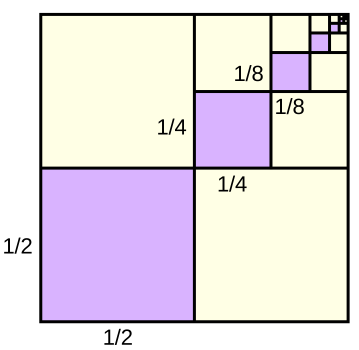
This is such a nice way to be thinking about potential wells. And we're having so much fun. And if we weren't tracking energy and trying to account for what happens to the MPE - does it ALL go to KE or not - we wouldn't be here... And the pooping of PE helps me relate the depth of the well to the amount of pooped PE.
Tuesday, March 13, 2012
Paper planning
After reading Rachel's blog, I'm inspired to map out some papers, presentations, and deadlines.
For the Biology Grant:
Order of attack:
1. SABER
2. SGSI Inquiry prize
3. Biology textbook (daily)
4. Inquiry book chapter (over spring break)
5. Flame Challenge - students (due April 2)
6. Grasp of Practice v. NOS surveys (Irene's writing right now)
For the Biology Grant:
- SABER: developing a physics/biology sequence for future elementary teachers. Due April 9.
- CBE-LSE: a longer version of conference paper, with a particular emphasis on PET diagrams and the cultural (?) differences between biology and physics when it comes to energy. Abstract due June 1. Final paper due in September.
- Transformative experiences presentation with Brian.
- Responsiveness? (See Rachel's blog post; maybe this would be a good place to talk about pacman? or zero speed?)
- I love the fungible/distinguishable question - would Sam work on this with me? is it a proceedings paper, or just a cute idea?
- What-is-work -- a prelude to the PRST-PER paper I hope to have done by then
- SGSI course - due early April
- "Creating Work" paper on work/energy theorem and modeling. (visit Seattle in May, submit in July; put on backburner until then.)
- Lambertian Surfaces paper with Richard, et al. (submit by end of summer - R's writing code now?)
- Biology textbook to publishers this June (keep editing daily)
- Inquiry book out shopping to publishers this May (finish Ch. 1 by April 15)
- Peer assessment paper - still waiting for reviews. Hopefully revise and resubmit soon?
- Flame Challenge - students (due April 2)
- Want to write that paper with Brian about electrons in a wire (seriously on the backburner)
- Schwartz' mechanism paper (student writing right now)
- Grasp of Practice v. NOS surveys (Irene's writing right now)
- Notebooks activity and results (per Sam's request; can't think of a good home for this paper)
Order of attack:
1. SABER
2. SGSI Inquiry prize
3. Biology textbook (daily)
4. Inquiry book chapter (over spring break)
5. Flame Challenge - students (due April 2)
6. Grasp of Practice v. NOS surveys (Irene's writing right now)
Monday, March 12, 2012
Trackable energy
I'm having my class enter the flame challenge and, in preparation for that, we're looking into the Gaussian Gun. It was a kind of non sequitur move, having just come to grips with RKE, but I really love that here's a way to have authentic audience around a big scientific question that requires them to put on their future-teacher hats. And I really want the explanation for the flame to include the Gaussian Gun.
So after puzzling over the Gaussian Gun and those PacMan pellets, we had a basic idea that the energy that came in was the energy that we got out. There was more KE on the way out because it didn't have to lose so much PE. In this, there was little discussion of the exiting ball having more energy than the incoming ball. It was there - the idea - but not explicitly so and not with the kind of amazement that I think that idea warrants. So they were assigned a homework problem to describe it however they wanted - diagrams, words, pellets, etc. We started there today.
Here are the three of the four outcomes (it's a small class - the fourth modified the diagram during class based on one students' ideas, so it's not representative of her initial ideas):


 That third image there has - in a way - done some energy tracking. When he went to put it on the white board to discuss, he added the "target" ball, and showed it having some MPE, too. As he presented he said "but that doesn't really matter...".
Ah, but it DID - as we tracked the balls going farther, all of them losing MPE as they travel away, all slowing down, only one ball was able to keep moving. (So I thought of Rachel and how much more useful that representation was than the PET diagrams or the text.) And this led us to a really cool discussion - we held those magnet/ball configurations in our hands:
So after puzzling over the Gaussian Gun and those PacMan pellets, we had a basic idea that the energy that came in was the energy that we got out. There was more KE on the way out because it didn't have to lose so much PE. In this, there was little discussion of the exiting ball having more energy than the incoming ball. It was there - the idea - but not explicitly so and not with the kind of amazement that I think that idea warrants. So they were assigned a homework problem to describe it however they wanted - diagrams, words, pellets, etc. We started there today.
Here are the three of the four outcomes (it's a small class - the fourth modified the diagram during class based on one students' ideas, so it's not representative of her initial ideas):


Ah, but it DID - as we tracked the balls going farther, all of them losing MPE as they travel away, all slowing down, only one ball was able to keep moving. (So I thought of Rachel and how much more useful that representation was than the PET diagrams or the text.) And this led us to a really cool discussion - we held those magnet/ball configurations in our hands:
||OO
and
O||O
And one student says "this one (the second one) has MORE something - it's hard to pull that ball off. I want to say it has more energy - but I know it doesn't" - so they decided it has more force, but less energy. And there was a moment of "huh" - we've invented this term, energy, but now it's telling us something about itself we wouldn't have predicted - that we didn't see as inherent to our definition.
Thursday, March 8, 2012
Pacman pellets, and my blog audience
As I mentioned... perhaps on facebook and not on the blog? -- my students have this idea that potential energy is stored in space (not in objects)-- like PacMan pellets-- that you collect as you fall to the earth. This is because v^2 changes linearly with distance, not with time, as things fall near the Earth's surface. So each meter has stored in it a "2g" dose of potential energy pellets that each kg of mass scoops up as it falls.
Today we began looking at the Gaussian Gun-- after some discussion centered around a O|O gun (which doesn't work) and a O|OOO gun (which does), followed by the inevitable and super fun task of trying to make the gun as destructive as possible (to which one student who is former military said: "this, you realize, is why military spending is out of control.")-- one student (author of the PacMan theory of PE), said the O|OOO is like a car with gas and the O|O is not. Another student said - no, it's not like it has gas. It's like the first one is on a ramp and the second one is not. I pushed him to say why the analogies were different.
This is what comes out:
Today we began looking at the Gaussian Gun-- after some discussion centered around a O|O gun (which doesn't work) and a O|OOO gun (which does), followed by the inevitable and super fun task of trying to make the gun as destructive as possible (to which one student who is former military said: "this, you realize, is why military spending is out of control.")-- one student (author of the PacMan theory of PE), said the O|OOO is like a car with gas and the O|O is not. Another student said - no, it's not like it has gas. It's like the first one is on a ramp and the second one is not. I pushed him to say why the analogies were different.

This is what comes out:
And what, pray tell, are those dots? Pacman pellets of potential energy! (The other ball will poop one on its way out. I told them of the facebook post with pacman "pooping pe" and they said "your physics colleagues think that's funny? That's awesome.") (And, if you look carefully at the whiteboard, you can see two slopes on the left that he erased as he drew this -- first a bowl shape, then a greatly-sloped shape, and then decided the slope should be symmetric. - This student is, right now, in his first semester of intro algebra-based-physics. I would be delighted if a quantum mechanics student could so carefully construct a potential well!)
Visiting class yesterday was a former student who is in the secondary credentialing program and wanted to come observe. And, noticing that they were conflating, subtly, the field and the potential energy in their conversations, he pressed the issue (in a way that felt overly teacherly to me, but the students responded really well, so what do I know?). - Anyway, we decided that the potential-to-deposit(poop)-pacman-pellets is always there, surrounding the magnet; but the pacman pellets themselves can only be there if there are TWO objects. The interaction creates the pellets. A single magnet in a universe unto itself would not have pellets around it. I nearly bursted with joy over this description.
And I was talking to Matty last week who is thinking about her next career step and is calling up friends to ask about their jobs. I said that if it was just me, reveling in my students' ideas, that would not be enough to sustain me professionally. I really really thrive on being able to share those ideas with my colleagues. It's making me think about our "imagined audience" (Brian Frank, another colleague who sustains me professionally, sent an ICLS paper about audience after I mentioned this to him)-- this blog, while I'm teaching, is my imagined audience. You're there in the class with me. I took out the cell phone to snap that picture of the white board because I wanted to share it with you. Students are also the audience, but the reflective moments of my teaching are less about the students and more about my professional development and colleagues. It does affect my teaching -- I blogged about my inquiry class every day during the grant funding for three semesters, and I noticed that when I didn't, my teaching suffered.
I'd really like to do a session/workshop/something at AAPT/PERC about the role of blogging in our professional lives.
Monday, March 5, 2012
The direct object and work and heat
Stamatis recently proposed a different definition of work (see work as I define it).
I noted that I want to claim:
"I think it is
I can say:
That is, for muffins at least, I cause a mouse to have a muffin by giving it to him.
However, headaches aren't this way:
That is, for headaches, I cause a mouse to have a headache, but not by giving it to him.
So my thought was that these two phrases:
But since both are seemingly valid ways to talk about work, I'd say we think of work as both a kind of motion and a kind of possession change. It has a flexible ontology, and that's good?
But what would we say about heat:
BUT WAIT! -- If you google this:
I noted that I want to claim:
Work is a transfer or transformation of energy that is mediated by a force.Stamatis writes:

"I think it is
the transfer (i.e., energy that crosses object boundaries) of energy mediated by a force, not any energy transfer/transformation mediated by a force.)At first, my attention was drawn to this distinction:
- work is the transfer of energyLater I realized that Stamatis would probably say those two statements are identical; the point he was making is that work is the transfer of energy, not the transformation of energy. I realized that and raised some questions about that claim. More on that later. Because in the meantime - when I thought Stamatis was claiming that "the transfer of energy" and "the energy transfer" were two different things - I was reminded of Pinker and his discussion of the dative case. Pinker notes:
- work is the energy transfer.
I can say:
I gave a mouse a muffin.
AND
I gave a muffin to a mouse.
That is, for muffins at least, I cause a mouse to have a muffin by giving it to him.
However, headaches aren't this way:
I gave a mouse a headache.
NOT
I gave a headache to a mouse.
That is, for headaches, I cause a mouse to have a headache, but not by giving it to him.
And Pinker says:
... in both cases, the thing that is construed as being affected is expressed as the direct object, the noun after the verb. So, when you think of the event as causing the muffin to go somewhere -- where you're doing something to the muffin -- you say, "Give the muffin to the mouse." When you construe it as "cause the mouse to have something," you're doing something to the mouse, and therefore you express it as, "Give the mouse the muffin." So which verbs go in which construction ... depends on whether the verb specifies a kind of motion or a kind of possession change. To give something involves both causing something to go and causing someone to have. ... And to give someone a headache causes them to have the headache, but it's not as if you're taking the headache out of your head and causing it to go to the other person, and implanting it in them. You may just be loud or obnoxious, or some other way causing them to have the headache.
- work is the transfer of energydiffer in what is the direct object of work. Work, in these two constructions, is either a transfer (what kind of transfer? a transfer of energy) or work is an energy (what kind of energy? one that was transferred). The first one is a reification of a step in energy theater. The second is not. (Except "is" is not the kind of verb that gets to have a direct object; only action verbs have direct objects. So that's a little glitch.)
- work is the energy transfer
But since both are seemingly valid ways to talk about work, I'd say we think of work as both a kind of motion and a kind of possession change. It has a flexible ontology, and that's good?
But what would we say about heat:
- heat is the transfer of energyTo me, the first sentence sounds better.
- heat is the energy transfer
BUT WAIT! -- If you google this:
- work is the transfer ... (68 million google hits)For some reason, work trends as a transfer, and heat trends as an energy.
- work is the energy ... (39 million google hits)
- heat is the transfer ... (1.04 million google hits for "heat is the transfer)
- heat is the energy ... (4.5 million google hits for "heat is the energy")
Sunday, March 4, 2012
Fungible and distinguishable

In response to Sam's blog post about the distinguishability of energy, here is a picture of a PET energy diagram for part of an ecosystem (eventually we will add in decomposers to make a big flow of energy, and we'll contrast this with a similar carbon diagram, which will show that carbon cycles, and energy flows).
Though not part of the curriculum, I have students treat this as a "choose your own adventure" story: 100 "calories" of energy come in from the sun... choose one of those calories and tell me what happened to it. All of those calories (in our story so far) become CPE in a glucose molecule in a plant as part of photosynthesis; then some participate in cellular respiration in the plant - and some of those wind up doing cell work, others become thermal energy... some get eaten by an animal, become part of a branched carb on a cell membrane... etc etc. -- each calorie has its own life story. And we tell that story as if each calorie is unique.
It's like the "where's george" game -- we take indistinguishable dollars (pragmatically indistinguishable, of course - dollars are, in the physics sense, distinguishable) and we make one distinguishable by putting a little tracking number on it; suddenly we can tell a better story about that dollar. Not because dollars aren't fungible - but despite their fungibility, they are distinguishable. Energy, of course, is both fungible and indistinguishable (unlike a dollar), but again, we can pretend it is fungible AND distinguishable (like "where's george") and that helps us create a narrative for energy. Through those narratives, we can examine patterns of similar narratives (hey, every time an energy changed form, a force was responsible...).
What it means to be fungible: ANY of these KE people can turn into a PE. What it means to be distinguishable: nonetheless, I can tell which KE person did turn into a PE.
So for money: I can use any dollar in my wallet to buy that cup of coffee (fungible) but I ultimately choose just one particular dollar from my wallet to buy that cup of coffee (distinguishable). And that dollar, then, takes a unique path through our economy.
For energy, however: I can use any calorie of GPE to convert to KE as a ball falls (fungible) and it would be silly to say that I "chose" one particular calorie (indistinguishable). BUT I CAN PRETEND that I "chose" one -- I lose nothing in pretending that this is the case. At least not in intro physics.
* Sam claims: There are no experimental consequences to choosing to treat energy as distinguishable or indistinguishable. -- but I think that's not true - if energy is indistinguishable, then its subject to bose-einstein statistics, and that has clear experimental consequences. (or am I conflating "energy is indistinguishable" with "photons are indistinguishable"?)
Saturday, March 3, 2012
So if we come in here...
Richard's visiting, and one of our favorite geeky things to do is find a good physics problem to work on together. (Sometimes these are even professionally productive!)
Our newest question has to do with modeling Lambertian surfaces.-- A white piece of paper, you may know, doesn't reflect like a mirror. But it also (which I didn't know at first) doesn't reflect uniformly in all 2π-steradians -- more light is reflected perpendicular to the surface than parallel to the surface. From what I've found, no one explains why matte surfaces should be (more or less) Lambertian. (All of this came up, as is so often the case with my physics questions - including the last one Richard and I solved- in my inquiry class. We were wondering about shadows from the sun, which led to all of this.)
So we took some paper with us to the brewery last night to figure this out over some beers. And because of Rachel's recent post, I was doing double-duty-- figuring out Lambertian surfaces and listening to Richard's use of language.
Sure enough, whenever he was trying to figure something out, he would position himself as a light ray -- but, interestingly enough, it wasn't just him. He would say "we" -- "If we're coming in like this... we would reflect here... wouldn't we?" It was all 'us' and 'our' and 'we.'
Some thoughts:
- is this because the two of us are working together to find a theory -- so it's "us" -- while if he had one idea and I had a competing idea, it would be "I"?
- or is this because we were modeling light rayS - it's a grouping of things, so we could wonder about both of us being light rays?
- or maybe it's because we're a couple?

Our newest question has to do with modeling Lambertian surfaces.-- A white piece of paper, you may know, doesn't reflect like a mirror. But it also (which I didn't know at first) doesn't reflect uniformly in all 2π-steradians -- more light is reflected perpendicular to the surface than parallel to the surface. From what I've found, no one explains why matte surfaces should be (more or less) Lambertian. (All of this came up, as is so often the case with my physics questions - including the last one Richard and I solved- in my inquiry class. We were wondering about shadows from the sun, which led to all of this.)
So we took some paper with us to the brewery last night to figure this out over some beers. And because of Rachel's recent post, I was doing double-duty-- figuring out Lambertian surfaces and listening to Richard's use of language.
Sure enough, whenever he was trying to figure something out, he would position himself as a light ray -- but, interestingly enough, it wasn't just him. He would say "we" -- "If we're coming in like this... we would reflect here... wouldn't we?" It was all 'us' and 'our' and 'we.'
Some thoughts:
- is this because the two of us are working together to find a theory -- so it's "us" -- while if he had one idea and I had a competing idea, it would be "I"?
- or is this because we were modeling light rayS - it's a grouping of things, so we could wonder about both of us being light rays?
- or maybe it's because we're a couple?
Friday, March 2, 2012
Next time I teach Advanced Inquiry
I started off the semester with energy project methods, and we've peppered the intellectual landscape with lots of questions and ideas about energy - it been great. But we've just recently honed in on quantifying energy -- and I think this is such a useful idea, and cuts to the heart of a lot of science and science teaching that I want to think about a different starting point for Adv. Inquiry next time I teach.
One central question driving us right now is why two wheels roll differently. I think I'd like to start with this question next time - start with the wheels, theorize where the "missing energy" is, describe carefully why would expect them to be the same and why this is a real puzzle, invent some solutions (is it friction? is one wheel "wobbly" and somehow using up energy that way? is it one wheel moves its mass more every time it spins around?) and then start investigating those.
It's really different from the EP approach, but it's led us to some cool discoveries - and I think an entire 15 weeks on the question of these two wheels could really be awesome. I wish I'd started this topic earlier.
So there's our cool slow-mo video (I love the cheap and amazing Exilim camera for physics labs!). And here's our data:
 There's the missing energy there on the right. Our current theory is the energy is there - and it's kinetic energy - but it's kinetic energy in the rotation and not the translation. Our best guess for RKE is (mass x "average circumference" x rpm). Will adding that in close the gap? By Monday I should know what they've done with this!
One central question driving us right now is why two wheels roll differently. I think I'd like to start with this question next time - start with the wheels, theorize where the "missing energy" is, describe carefully why would expect them to be the same and why this is a real puzzle, invent some solutions (is it friction? is one wheel "wobbly" and somehow using up energy that way? is it one wheel moves its mass more every time it spins around?) and then start investigating those.
It's really different from the EP approach, but it's led us to some cool discoveries - and I think an entire 15 weeks on the question of these two wheels could really be awesome. I wish I'd started this topic earlier.
So there's our cool slow-mo video (I love the cheap and amazing Exilim camera for physics labs!). And here's our data:

An ontology for work
Something that came up in our writing group yesterday - an idea for a paper - was to present definitions and use of the idea of "heat" from a range of intro textbooks and for "work" from a range of intro textbooks and argue that there is a remarkable and problematic ambiguity surrounding the idea of work. (I could also claim that this ambiguity for 'work' indicates a non-modeling approach to energy.- Hard claim to make, but I believe it.)
In this paper I'm working on, I make the following assertion:
we assert an alternative definition for work as a change in energy (a transfer of energy from one object to another or transformation of energy from one form to another) caused by a force.And I want to show that this definition has advantages to the noncommittal ontology of work that peppers physics textbooks. (It would be interesting to think through the definition of work when using a 'spatial' metaphor for energy...)
Brian just helped make the case today! --- and it started with an observation from my students!
Thursday, March 1, 2012
App development?
I learn a lot about energy every time I try to make my own 'energy movie' (it's like energy theater for the digital age). It started when I realized students just weren't understanding PET Source/Receiver diagrams, and I wanted them to think about these blobs of energy actually moving from place to place:
I make these videos using apple keynote and quicktime, but you have to be a pretty savvy user of Keynote and "magic move" and plan everything out in advance - simple changes (like deciding you should have had a few more calories in the beginning) mean starting completely over. In a big lecture, students might follow one blob and then tell its life story - "okay - those of you following energy blob one, what happened to you? why?" - and we have conversations about energy transfers and transformations.
I would love it if students could create these, and so for the last year I've had in my mind a really cool iPhone/iPad/mac app for energy theater. It starts with you defining the "objects" that will be relevant and the types of energy that will be relevant. You might say you're interested in 10 steps in time, 3 different objects (hand, ball, earth?), and 3 kinds of energy (CPE, GPE, KE), and 30 calories. The app then generates a 10 frame movies, each frame has outlines of these objects, and for each "frame" of the movie you then move the blobs around (so frame one you position all the blobs where they need to be. then you move to frame two - they are all in the same place as they were in frame one, so you move them again, turning some into KE from a GPE, say. when you think you've got that set, you go to frame 3...). When you're done getting it how you want it, you "run it" - and play teh movie. You can then ask the app to generate a pie chart for you, or a energy transfer diagram, or a KE/time graph or whatever. You could plug them in and share with the class and discuss different energy movies and which one is right. It would be so amazing!
In my biology class we wind up making PSET diagrams of ecosystems - using this app for that would be really cool.
Included in the app could be energy theaters for some fascinating scenarios (the fridge!).
Is this a TUES grant? a pro-bono-during-summer gig that I sell for $1 and hope to recoup the cost of my time? Or am I the only one who would find this to be super cool? I like programming, so this sounds fun.
I make these videos using apple keynote and quicktime, but you have to be a pretty savvy user of Keynote and "magic move" and plan everything out in advance - simple changes (like deciding you should have had a few more calories in the beginning) mean starting completely over. In a big lecture, students might follow one blob and then tell its life story - "okay - those of you following energy blob one, what happened to you? why?" - and we have conversations about energy transfers and transformations.
I would love it if students could create these, and so for the last year I've had in my mind a really cool iPhone/iPad/mac app for energy theater. It starts with you defining the "objects" that will be relevant and the types of energy that will be relevant. You might say you're interested in 10 steps in time, 3 different objects (hand, ball, earth?), and 3 kinds of energy (CPE, GPE, KE), and 30 calories. The app then generates a 10 frame movies, each frame has outlines of these objects, and for each "frame" of the movie you then move the blobs around (so frame one you position all the blobs where they need to be. then you move to frame two - they are all in the same place as they were in frame one, so you move them again, turning some into KE from a GPE, say. when you think you've got that set, you go to frame 3...). When you're done getting it how you want it, you "run it" - and play teh movie. You can then ask the app to generate a pie chart for you, or a energy transfer diagram, or a KE/time graph or whatever. You could plug them in and share with the class and discuss different energy movies and which one is right. It would be so amazing!
In my biology class we wind up making PSET diagrams of ecosystems - using this app for that would be really cool.
Included in the app could be energy theaters for some fascinating scenarios (the fridge!).
Is this a TUES grant? a pro-bono-during-summer gig that I sell for $1 and hope to recoup the cost of my time? Or am I the only one who would find this to be super cool? I like programming, so this sounds fun.
Subscribe to:
Posts (Atom)